
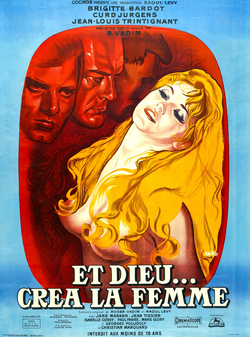
Behind the film
- Year
- 1956
- Director
- Roger Vadim
- Writers
- Roger Vadim, Raoul Lévy
- Genres
- Drama, Romance
- Country
- France, Italy
- Cast
- Brigitte Bardot, Curd Jürgens, Jean-Louis Trintignant, Isabelle Corey, Christian Marquand, Jane Marken, Jean Tissier, Jean Lefebvre
About the film
Contains story spoilers.
And God Created Woman follows Brigitte Bardot's Juliette Hardy in Saint-Tropez, where her guardians threaten to return her to an orphanage. Antoine Tardieu refuses to marry her; his younger brother Michel offers to do so, although she still wants Antoine. The connection between dancing and this tangled family story preceded the film. Scott Murray's account in Senses of Cinema quotes Vadim remembering an evening in Rome when he watched Bardot dance. He recalled a newspaper story about a young woman involved with three brothers, one of whom she killed. Watching Bardot, he began making notes for a film. Murray then describes his approach to producer Raoul Lévy in Paris. That recollection gives the drama a violent starting point, though the released film takes Juliette's marriage towards a different ending.
Michel and Juliette's wedding offers a more intimate kind of defiance. Writing for the British Film Institute, Ginette Vincendeau draws attention to the couple making love while the wedding lunch waits downstairs. She sees Juliette as a woman expressing desire for herself, alongside her obvious appeal to male spectators. The meal matters because it brings that desire into conflict with a family occasion: the couple choose their own pleasure over the gathering arranged around their marriage. Vincendeau also finds something fresh in Bardot's casual manner and cheeky delivery. Her performance avoids a heavily theatrical display of feeling, making Juliette's appetite seem ordinary to Juliette even when others find it outrageous. In this reading, her lack of embarrassment carries as much weight as the amount of skin Vadim allows the audience to see.
The clothes help establish that casualness. The Cinémathèque française's account of Bardot's Repetto flats describes a youthful style apart from the haute couture associated with film stars. Before shooting, Bardot ordered a carmine-red Cendrillon model from Rose Repetto, taking the ballet shoe into everyday wear. The low-cut shoe exposes the base of the toes; bare feet offer another version of the same informal image. Repetto later donated red lambskin flats of the 1956 model to the museum. Michael Atkinson's Turner Classic Movies essay looks at what Vadim does with such informality. Clothes seem casually thrown on, while Bardot's posture directs attention as strongly as the garments themselves. Atkinson singles out the boat sequence, which puts her into the water and brings her out in soaked clothing. His reading makes the rescue part of the film's arrangement of Bardot for the spectator. He also explains the enthusiasm of young Cahiers du cinéma critics through Vadim's confidence in his own preoccupations and their preference for a distinct writer-director over conventional professional polish.
Wealthy Carradine wants the Tardieu family's shipyard for a casino development and offers them a stake in his marina. Antoine returns through the deal. After rescuing Juliette from a burning boat, he sleeps with her on a beach. Chuck Stephens's Criterion essay finds tension between Juliette's natural impulses and the conventions around her: even her wedding dress appears less comfortable than her bare feet. His account of the film's censorship concerns what spectators imagine they see. Retelling Vadim's memoir, Stephens describes a censor demanding the removal of apparent nudity. Vadim showed the passage again: Bardot was wearing a black leotard. According to this recollection, the censor then suspected that a different version had been substituted. An American dispute had more immediate consequences for exhibitors. A contemporary TIME report describes Philadelphia prosecutors confiscating the film from two cinemas and charging their owners under an obscenity provision. Mayor Richardson Dilworth opposed the action. Pennsylvania's Supreme Court issued an injunction allowing the screenings to continue while a local court considered the case. TIME reported larger crowds after the cinemas reopened. Its account captures a specific interruption and reopening, with officials disagreeing over whether audiences should be allowed to watch the film.
Bardot remembered the dancing itself more simply. In a 2016 interview with Agence France-Presse, she said the mambo was improvised: she responded to the music and followed her instincts. She also recalled loving a role written specifically for her and being surprised by the fame it brought. Saint-Tropez remained part of that memory, a fishing village she remembered before the crowds, and she disliked reaching the end of the shoot. Her recollection locates the sequence in the pleasure of performing it, rather than in the arguments that later surrounded her screen image. Juliette confesses to Christian, the youngest brother; their mother tells Michel about the affair, and he goes looking for her. Michel finds her at a bar. Juliette keeps dancing when her husband arrives with a gun. Carradine is wounded intervening. He leaves for treatment with Antoine, whom he reassigns elsewhere. Michel repeatedly slaps Juliette; the couple then leave hand in hand. Stephens questions the idea that Vadim alone created Bardot's screen identity, finding a presence that exceeded his control. The ending leaves that freedom beside a husband's violence, within the marriage Juliette and Michel continue.