
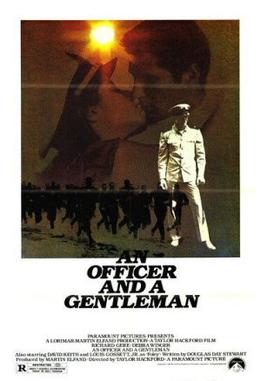
Behind the film
- Year
- 1982
- Director
- Taylor Hackford
- Writers
- Douglas Day Stewart
- Genres
- Romance, Drama
- Production
- Lorimar Television, Paramount Pictures
- Country
- United States
- Cast
- Richard Gere, Debra Winger, Louis Gossett Jr., David Keith, Lisa Blount, Robert Loggia, Tony Plana, Harold Sylvester
About the film
Contains story spoilers, including the ending.
An Officer and a Gentleman follows Zack Mayo into naval aviation officer training at Port Rainier in Washington. Richard Gere plays Zack, Debra Winger is Paula Pokrifki, and Louis Gossett Jr. plays drill instructor Emil Foley. Zack has grown up with an unreliable sailor father after his mother's suicide. He approaches training as a way out, while keeping other people at a distance. Foley discovers his illicit business supplying polished boots and buckles and subjects him to a punishing weekend. Zack finally admits he has nowhere else to go. Away from the base, his relationship with factory worker Paula grows alongside his friendship with fellow candidate Sid Worley. When Sid leaves training, Lynette rejects him and admits she is not pregnant. Zack and Paula later find that Sid has died by suicide. Zack eventually graduates, thanks Foley, and goes to Paula's factory, carrying her away as her coworkers applaud.
Screenwriter Douglas Day Stewart drew on his own Navy experience, although the story took years to take shape. He recalled being so occupied with the difficulty of military school that he could scarcely think beyond the work in front of him. Celestial navigation and aerodynamics were among the subjects he struggled to master. He began writing while still serving, but the experiences only developed into this screenplay after he left. Stewart wanted to avoid the military inaccuracies he and others had complained about when watching films. He became a producer and brought in military advisers who knew contemporary service life. That commitment did not secure official Navy support. In Stewart's account, the service objected to the disreputable father and the instructors' profanity, so the production used a former military base that had become parkland. His recollections connect the film's romance with an effort to portray a demanding workplace whose people could be difficult, flawed and recognisable.
Director Taylor Hackford saw Zack's emotional defences as a central acting problem. He admired Gere's screen presence but wanted to reach beyond the polished exterior audiences already knew. The screenplay gave him a man protected by layers of emotional armour; for the drama to work, viewers had to feel what was underneath. Hackford discussed that aim with Gere, who agreed to the challenge. In recalling the scene where Zack admits he has nowhere else to go, the director linked the emotional collapse to the physical demands placed on the actor. The mud and exhaustion accompanied the moment when Zack's refusal to yield finally became an admission of need. Hackford's account gives the training scenes a purpose beyond demonstrating endurance. The pressure allows a guarded character to become vulnerable in front of another man, and allows the audience to see something his confident appearance has concealed.
Casting Foley changed after Hackford visited the flight-training centre in Pensacola, Florida. He later said the part had originally been written for a white actor. Seeing instructors of colour at the real centre led him to change the casting profile, and Gossett became the man entrusted with authority over the candidates. Hackford wanted that performance to convince Marines themselves. He described the challenge as getting members of a demanding organisation to recognise Gossett's character as one of their own. In the same interview, he placed An Officer and a Gentleman among his films about working-class people seeking a way to improve their circumstances. Here the military provides that route. His interest was in the institutions and occupations through which people can move beyond the lower rungs of society. Foley's credibility and Zack's desire to progress belong to that same social setting: this training has consequences for the life Zack hopes to lead.
Gere remembered the location as an active part of the production's atmosphere. Filming around Port Townsend, Washington, brought the cast to rough coastline far from the modern world as he experienced it. He described the area's natural beauty alongside the scarcity of employment, and felt that the landscape influenced the work. The shoot also required considerable physical effort. Gere recalled long filming days followed by karate practice, leaving him exceptionally lean and fit. He and Hackford had already worked with Stewart on making the script tougher, because his first impression had been that it was overly sentimental. The intention was still to tell a romantic story, but one grounded in the difficult circumstances surrounding the couple. Gere said that playing its surface would not have been enough; he needed to commit himself fully to the situation. His memories bring together the coastal location, the demanding schedule and the effort to give the romance weight.
That balance was tested most openly by the factory ending. Gere initially thought the scene was too sentimental for the tough film they were making. Hackford persuaded him to shoot it, and Gere committed to the performance despite his reservations. Even after filming, he did not expect it to work. Early cuts used different music, and another used the eventual music at a different tempo; neither convinced him. Then he watched a cut in which the tempo had changed again and felt the scene come together. He remembered getting chills at the result. The final image depended, in his account, on more than the action of carrying Paula through the factory. The pace of the music changed how that action felt within the film. An ending he had questioned on the page and during production became one he could finally believe when performance, editing and music met.