
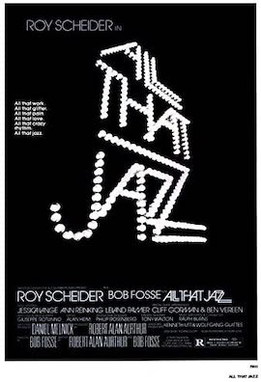
Behind the film
- Year
- 1979
- Director
- Bob Fosse
- Writers
- Bob Fosse, Robert Alan Aurthur
- Runtime
- 123 minutes
- Genres
- Musical, Flashback, Drama, Biographical
- Production
- Columbia Pictures
- Country
- United States
- Cast
- Jessica Lange, Roy Scheider, Ann Reinking, Leland Palmer, Max Wright, John Lithgow, Keith Gordon, Sandahl Bergman
About the film
Contains story spoilers, including the ending.
All That Jazz follows Joe Gideon, a Broadway director whose crowded working life is coming apart. Roy Scheider plays Joe, who is rehearsing a musical while editing a feature film and struggling with addictions, affairs and the needs of his daughter. Jessica Lange plays Angelique, the figure through whom he imagines death. Bob Fosse directed the 1979 musical drama and wrote it with Robert Alan Aurthur. Its backstage world lets dance serve several purposes: professional work, private expression and an imagined farewell. Joe can command a room full of performers, yet he cannot bring the same discipline to his own behavior. The film's movement from the audition sequence set to On Broadway toward Bye, Bye Life follows a man who continues turning experience into a show while his ability to survive that experience steadily diminishes.
Joe's girlfriend Kate discovers his affair with dancer Victoria, while his daughter Michelle struggles to secure time with him. His ex-wife Audrey remains part of his professional world. He pushes the choreography of Take Off With Us into provocative territory, then doubts the film he has been editing. Hospitalization interrupts the musical, and its producers consider a replacement director. Joe keeps smoking and entertaining visitors despite medical orders. After watching a hostile television review, he suffers a heart attack and learns that two arteries are blocked. Surgery brings no lasting escape from danger. The producers learn that his death could yield an insurance profit. Joe imagines Michelle, Kate and Audrey performing numbers about his mortality, then returns to intensive care after another crisis. In delirium, he wanders the hospital before being brought back to bed. His final imagined show pairs him with entertainer O'Connor Flood for a farewell set to Bye, Bye Love. Joe says goodbye to people from his life and moves toward Angelique. The fantasy ends with his body sealed in a hospital bag. The applause of an imagined audience cannot change that physical ending.
The choreography of Take Off With Us develops alongside Joe's attempts to make an unpromising song work onstage. The dancers initially move together through the slouched postures, repeated gestures, hats and gloves associated with Fosse's style. A break changes the movement into something slower and more flowing before the tempo increases again. The number finally returns to insistent repetition, with the dancers facing outward toward their audience. In its discussion of the scene, Harvard Film Archive connects those changes to the promises and disappointments of sexual liberation. Within the rehearsal story, the sequence also shows Joe making a creative decision that unsettles the people financing the musical. A routine begins as a problem for its director and becomes a performance whose physical directness exceeds what the producers expected. The dancers' bodies carry an argument that the polite discussion afterward cannot easily contain.
The story draws on Fosse's life while remaining a work of fiction. His simultaneous work on Chicago and Lenny, his health crisis and his relationships helped shape Joe's circumstances. Ann Reinking, who plays Kate, had been Fosse's partner, but still had to audition for the role. Leland Palmer's Audrey echoes Gwen Verdon. Fosse and Aurthur also drew inspiration from Hilma Wolitzer's novel Ending, a book concerned with death. Richard Dreyfuss was originally attached to play Joe before Roy Scheider took the part. The production used New York locations and Astoria Studios, joining working city spaces to constructed musical environments. Completion itself required another studio's help: Columbia declined to fund the costly finale as the budget grew, and Twentieth Century-Fox supplied financing. The large farewell sequence was therefore both the destination of Joe's imagined performance and a substantial production problem. Its scale depended on a financial rescue near the end of filming.
Sound makes Joe's withdrawal during a table read audible. As the assembled cast reads and laughs, the soundtrack eventually removes the room around him and isolates his own small movements. Fingers tap, a cigarette is extinguished and a pencil breaks. Supervising sound editor Maurice Schell recalled that much of the sequence was already specified in the screenplay. The isolated noises draw attention to the director's irritation and distraction without requiring him to explain either feeling. Fosse later decided that the finger snaps were wrong and recorded replacements himself. He also performed the foot sounds for a flashback showing the young Joe dancing in a burlesque club. Schell supplied changing sound mixes while Fosse and editor Alan Heim worked on the picture, allowing the film to be cut with increasingly developed audio. For studio dance scenes, four performers returned to record their own footsteps. They knew the choreography well enough to recreate the movements quickly. The musical's sound therefore includes carefully reconstructed physical actions as well as its songs, from a dancer's step to the abrupt noise of Joe breaking a pencil. The finished passage lasts about ninety seconds, roughly half its original length.