
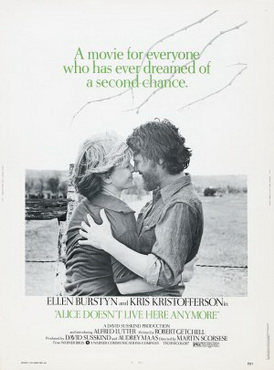
Behind the film
- Year
- 1974
- Director
- Martin Scorsese
- Writers
- Robert Getchell
- Runtime
- 1h 52m
- Genres
- Romance, Drama, Comedy, Romantic comedy
- Production
- Warner Bros. Entertainment, Warner Bros. Pictures
- Country
- United States
- Cast
- Ellen Burstyn, Kris Kristofferson, Alfred Lutter, Diane Ladd, Vic Tayback, Lelia Goldoni, Harvey Keitel, Jodie Foster
About the film
Contains story spoilers.
Martin Scorsese's Alice Doesn't Live Here Anymore is a 1974 drama written by Robert Getchell and starring Ellen Burstyn as Alice Hyatt. Alfred Lutter plays her son Tommy, Harvey Keitel is Ben and Kris Kristofferson is David. Alice's journey begins after the death of her husband, when she decides to pursue the singing career she put aside. The route leads west from New Mexico toward Monterey, California, but the destination remains subject to practical interruptions. Money, a place to sleep and the care of an eleven-year-old child repeatedly determine how far the pair can travel.
Phoenix appears to offer a way to keep the plan alive. Alice finds work as a lounge singer and begins a relationship with Ben, whose attention conceals the fact that he is married. His wife Rita's arrival exposes the situation, and Ben's violent response makes remaining there unsafe. Alice takes Tommy away to Tucson, spending money on an escape that removes her from the work she had found. Her movement across the Southwest is consequently more than a route toward an ambition. Each stop can create a vulnerability, and leaving a dangerous man does not supply the resources needed to continue independently.
The film introduces Alice's ambition through a deliberately artificial childhood sequence. The credits appear over satin, accompanied by Alice Faye singing You'll Never Know, and the opening uses the narrower proportions associated with older Hollywood movies. An eight-year-old Alice stands in a vermillion-tinted, studio-built world and announces that she will become a singer. The present-day story follows that bright promise with a much less settled adult life. Putting the two kinds of image together gives the dream a history: professional singing is something Alice has carried forward from childhood, even while marriage and motherhood have postponed its pursuit. The prologue also makes old movie glamour part of her remembered horizon.
In Tucson, a diner provides income and a new collection of relationships. Alice works alongside the outspoken Flo and the quieter Vera, and encounters David, a divorced rancher who becomes interested in her. His growing bond with Tommy makes him part of a prospective family arrangement as well as a romance. The relationship is disrupted when David uses physical force to discipline the boy. Alice's response keeps the question of her son's treatment within the decision about her own future. A kind manner toward her cannot by itself settle whether a man belongs in their life together.
Scorsese kept the camera in almost constant motion to reflect Alice's uncertainty and emotional upheaval. The performances also drew on material developed outside the written scenes. Tommy's repetitive joke during a car journey came from a story Lutter told the director on a drive to a location. Burstyn supplied memories and improvised dialogue, including Alice's account to David of performing an act with her brother. For the singing itself, she spent six months working with piano and voice teachers rather than relying on a substitute singer. These details place preparation beside spontaneity: the apparent looseness of conversations was supported by rehearsal, personal recollection and specific skills acquired for the role.
Burstyn had unusual influence over the project. She wanted its central perspective to belong to a woman and chose Scorsese after his work on Mean Streets. She also sought women for prominent jobs, with Marcia Lucas editing and Toby Carr Rafelson handling the production design. During development, Burstyn and Scorsese made a videotape in which she played Alice twenty years later. They used that exercise to reconsider scenes and dialogue, passing the material to Getchell for rewriting. Imagining the character beyond the story's immediate events gave the collaborators a further way to test her voice. The script evolved through this exchange rather than remaining a fixed document that the actors simply performed.
The film appeared during the changes in American cinema that Burstyn associated with the political and social ferment of the 1970s. She later connected opportunities for actors and directors to the period's willingness to question inherited rules and attempt unfamiliar forms of expression. Alice was one of comparatively few New Hollywood films built around a woman in the leading role. Burstyn's involvement is part of that context as well as a detail of its production: an actress could help develop a project, select a young director and bring her own experiences into the character. Her performance won the Academy Award for best actress, following the demanding mother role she had played in The Exorcist.
Alice and David ultimately reconcile, with the possibility of moving to Monterey placed back on the table. The ending does not show Alice arriving there or establishing her career. Instead, mother and son walk together toward a sign for the Monterey Dining Room, allowing the name of the intended destination to reappear in their present surroundings. Tommy's complaint when Alice hugs him too tightly keeps their exchange playful and physical. The final pair remain Alice and Tommy, carrying the relationship that has continued through each departure, job and romantic disappointment.