
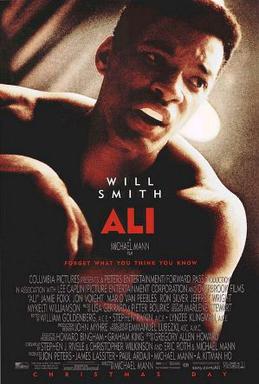
Behind the film
- Year
- 2001
- Director
- Michael Mann
- Writers
- Stephen J. Rivele, Christopher Wilkinson, Eric Roth, Michael Mann, Gregory Allen Howard
- Genres
- Biographical, Drama, Boxing
- Production
- Sony Pictures, Jon Peters, Overbrook Entertainment
- Country
- United States
- Cast
- Will Smith, Jamie Foxx, Jon Voight, Mario Van Peebles, Ron Silver, Jeffrey Wright, Mykelti Williamson, Jada Pinkett Smith
About the film
Contains story spoilers, including the ending.
Ali dramatises the years from the 1964 Sonny Liston fight to the 1974 Rumble in the Jungle. Will Smith plays the boxer in Michael Mann's film, which follows the changes in his identity as closely as his career. Cassius Clay becomes Muhammad Ali after embracing Islam. His friendship with Malcolm X and his place within the Nation of Islam bring competing loyalties into his life. Refusing induction into the military costs him his title and the right to box, turning his principles into a threat to his livelihood. Sportscaster Howard Cosell, played by Jon Voight, remains both an interviewer and a friend. Their public exchanges continue alongside Ali's struggle with the government and his eventual return to competition.
The film begins with Clay preparing to face Liston, then winning when the champion fails to come out for the seventh round. His first marriage, to Sonji Roi, breaks down over the expectations surrounding his religious life. He distances himself from Malcolm X in obedience to Elijah Muhammad and is devastated by Malcolm's assassination. The draft refusal brings a conviction and years away from boxing. Ali marries Belinda Boyd, returns to the ring and beats Jerry Quarry, but loses his challenge to Joe Frazier. The championship eventually passes to George Foreman. In Zaire, Ali prepares to face Foreman while his relationship with Veronica Porche causes a confrontation with Belinda. His attention remains fixed on the coming fight. Against Foreman, he spends long stretches leaning against the ropes, letting the champion exhaust himself before landing the knockout that restores his title. The ending closes this decade with a sporting victory after the losses and exclusions that have interrupted it. It does not take the story into Ali's later career or settle the damage within his marriages.
Mann described the film's central movement as Ali deciding who he would become. The African sequences give that question a setting beyond the American boxing business. Mann connected Ali's 1964 visit to Accra with the experience of finding himself among a Black majority rather than a minority. Later, a run past murals makes visible what supporters have invested in him. Their images imagine Ali defeating illness and weapons as well as Foreman. Mann understood those pictures as expressions of possibility from people who identified with someone rising from below. The adoration supplies encouragement before the fight, but also makes the contest carry hopes beyond the belt. That helps explain why the Rumble in the Jungle is the film's destination. Ali's recovery of the championship arrives after a widening sense of whom he represents. Mann also wanted mistakes to remain in the portrait. He recalled Ali identifying the failure to reconcile with Malcolm X before his death as a regret, keeping that broken friendship within the account of a man learning to define his loyalties.
The religious commitment belongs to that struggle over self-definition. Smith described Ali's faith as the element that helped him understand the character's ability to accept the consequences of his choices. In his account, comfort with God's will could sustain Ali whether his circumstances brought wealth or hardship. Smith also understood the refusal to fight in Vietnam as a use of American freedom of speech: challenging the government's actions was part of citizenship. Those were the actor's stated ways into the role, rather than a claim that the film resolves every political argument surrounding Ali. His faith gives the refusal a personal foundation, while the threatened punishment makes the choice costly. Smith said Ali's family wanted the marital failings included, too. Conviction in public life did not excuse the hurt within his private relationships.
Ali's speech required a different kind of attention from his fighting stance. Smith noticed that the boxer treated conversation as a form of performance, waiting for an answer before coming back with another burst of jokes. He compared the timing to exchanging punches. With Cosell, the purpose of the verbal contest could be to draw the other man closer and share warmth. That observation connects the public persona to a particular relationship, rather than reducing it to a collection of famous phrases. Ali visited during filming, and Smith described his reactions as a daily source of encouragement. The wish to satisfy Ali and his family gave the portrayal an audience close to its subject before the wider public ever saw it.
Smith had spent years declining the role because he doubted he could carry the responsibility of playing Ali. Mann persuaded him by setting out a practical course of preparation: expert boxing training and close study of Ali's daily life, family and outlook. Smith worked on his body and voice and studied Islam with an instructor. He identified physical training and the dialect as especially difficult parts of the preparation. The plan gave him a route from admiration toward an achievable performance. Rather than relying on recognition of the champion's appearance, he had to learn the movements and speech through which this version of Ali would occupy a gym, answer an interviewer and face an opponent. The preparation joined those familiar public actions to the religious convictions carrying him through the years away from the ring.