
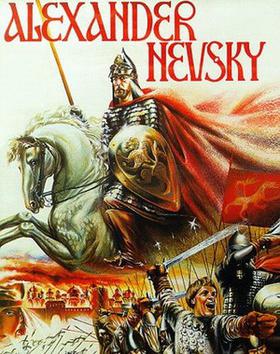
Behind the film
- Year
- 1938
- Director
- Sergei Eisenstein, Dmitri Vasilyev
- Writers
- Sergei Eisenstein, Pyotr Pavlenko
- Runtime
- 1h 52m
- Genres
- Drama, Biographical, Epic, Historical
- Production
- Mosfilm
- Country
- Soviet Union
- Cast
- Andrei Abrikosov, Nikolay Cherkasov, Nikolay Okhlopkov, Dmitry Orlov, Vasily Novikov, Sergei Blinnikov, Varvara Massalitinova, Valentina Ivashova
About the film
Contains story spoilers.
After images of battle-scarred ground, Alexander works among fishermen at a lake. A Mongol envoy offers him a place in the Golden Horde; Alexander refuses, saying the German threat is nearer. In Novgorod, Vasili Buslai and Gavrilo Oleksich joke as they court Olga. Their rivalry is still playful when a bell summons the city. Refugees report that Teutonic forces have taken Pskov, turning the assembly’s debate toward whether Novgorod will resist.
The assembly divides over resistance. Merchants and boyars argue against a fight; the monk Ananias urges submission and later proves aligned with Tverdilo, the Pskov leader who sides with the Order. Scenes of the occupation make the stakes concrete. Pskov’s voivode Pavsha is executed after resisting the knights, and his daughter Vasilisa joins the struggle. The film also shows children killed as a Catholic churchman blesses the violence. Ananias and this churchman are separate figures: one betrays Novgorod, while the other appears with the occupying force in Pskov.
Novgorod’s emissaries ask Alexander to lead a defence. He accepts, framing it as a fight for the Rus lands rather than a favour to one city, then calls ordinary people to join him. Smiths make weapons and armorer Ignat distributes them, including a chain shirt too small for himself. Vasili and Gavrilo ask Olga to choose between them; she will marry whoever proves braver in battle. Vasilisa also joins the army, carrying Pskov’s loss into the campaign. The threatened city now has a commander, volunteers and personal contests that the coming fight will settle.
Ananias warns Tverdilo about the Russian advance guard hidden in the forest. The Teutonic knights attack the detachment, led by Vasili and Domash Tverdislavich; Domash is killed before the main battle. As Alexander’s forces wait for news, Ignat tells a bawdy fable about a hare and fox trapped between trees. Its image helps Alexander explain how to contain a heavier force. He chooses the frozen lake as the battlefield and plans to let the German wedge advance while Russian troops strike at its sides. The plan combines attacks on the flanks with a battlefield where the heavily armoured enemy is at a disadvantage.
The Battle on the Ice opens with a long wait and distant movement across the horizon. The Teutonic force advances in a wedge; the film cuts between its massed ranks and close views of fighters in the clash. Vasili’s detachment takes the first blow, while Gavrilo and Alexander lead attacks on the flanks. Vasilisa helps Vasili when he is surrounded and loses his weapon, and the two friends continue to measure their courage against each other. Alexander defeats the Order’s Master. Vasilisa pursues and kills Ananias, while Ignat captures Tverdilo. When Ignat turns at the sound of the German war horn, Tverdilo stabs him from behind. The armorer’s death darkens the victory just before the knights’ formation breaks.
The retreating knights gather near their war horn, and the ice cracks beneath them; some fall into the water. Victory does not lead straight to celebration. In the night sequence known as the Field of Death, bodies cover the ground. Vasili and Gavrilo find each other alive, while Olga searches for them. Each friend insists the other fought more bravely. In the final return to Pskov, the dead are carried before the victorious army and the captives follow. Alexander frees the foot soldiers, saying they were compelled to fight, but keeps the knights for ransom. Tverdilo is handed to the people he betrayed. Olga chooses Gavrilo, and Vasili names Vasilisa the bravest and his intended bride.
Eisenstein and Pyotr Pavlenko recast the medieval conflict as a 1938 political drama. The Mongol threat appears only at the opening; the film then focuses on the Teutonic invasion. Its enemy imagery and call for collective defence reflect the period in which it was made. Novgorod’s lively public assembly and open-air recruiting contrast with the formal, church-centred Teutonic camp. The crowd, soldiers and named fighters each affect the outcome: recruitment supplies Alexander’s army, Vasilisa brings Pskov’s losses into battle, and the rivalry of Vasili and Gavrilo gives the fighting a personal thread. Alexander’s final address to Pskov joins those strands in a declaration that Rus has survived.
Prokofiev’s score is closely joined to Eisenstein’s editing. Sometimes images were cut to recorded music; elsewhere, music was composed to fit edited footage, allowing picture and sound to shape each other. In battle, themes associated with the Russian and German forces combine, then shift as the balance changes. Broad views of formations alternate with close-ups of individual fighters. After the battle, the camera pans over dead soldiers as the choral sound falls away and a contralto sings a lament. The winter landscape was built in summer near Moscow: painted, chalked trees and an artificial ice surface of asphalt and glass, supported by pontoons that could be deflated for the collapse. The lake is a constructed stage whose failure completes Alexander’s plan.