
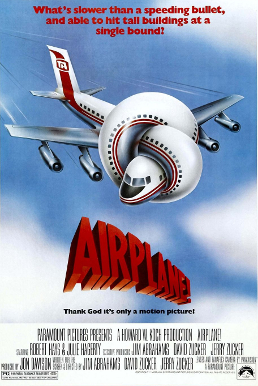
Behind the film
- Year
- 1980
- Director
- Jerry Zucker, Jim Abrahams, David Zucker
- Writers
- Jim Abrahams, David Zucker, Jerry Zucker, Arthur Hailey, Hall Bartlett
- Runtime
- 1h 28m
- Genres
- Comedy, Parody, Disaster, Slapstick
- Production
- Paramount Pictures
- Country
- United States
- Cast
- Julie Hagerty, Robert Hays, Lloyd Bridges, Leslie Nielsen, Peter Graves, Robert Stack, Kareem Abdul-Jabbar, Jonathan Banks
About the film
Contains story spoilers.
Airplane! takes the familiar disaster-movie emergency as its starting point. It follows the serious procedures and faces expected from that genre while interrupting them with absurd visual details. At the airport, former fighter pilot Ted Striker tries to stop Elaine Dickinson from leaving on a flight to Chicago. She has ended their relationship and requested a transfer. Ted gets a ticket and follows her aboard, although his wartime experiences have left him afraid of flying and unable to keep a steady job.
Ted’s attempt to win Elaine back does not go well. She continues working as a stewardess and keeps her distance while he tells long, increasingly unbearable stories to other passengers. In the cockpit, Captain Clarence Oveur and co-pilot Roger Murdock keep the plane moving toward Chicago, with Roger also trying to reassure a child who is more interested in whether he is really Kareem Abdul-Jabbar. Leslie Nielsen’s Dr. Rumack moves through the cabin as the physician; his calm responses become part of the film’s running pattern, where alarming news is delivered as if it were routine. The passengers and crew receive a choice of steak or fish, and those who eat the fish begin to fall ill.
The food poisoning incapacitates the pilots as well as many of the passengers. Elaine reaches the cockpit and contacts Chicago’s air-traffic controller Steve McCroskey, who tells her to activate the aircraft’s autopilot. It is a large inflatable figure named Otto: it can keep the plane on course but cannot land it. Rumack traces the illness to the fish and helps explain how quickly it has spread. The situation leaves Elaine responsible for keeping the passengers calm and relaying instructions, while McCroskey tries to find someone aboard with the skill to take over the controls. The emergency is real within the story, even as nearly every stage invites a visual or verbal gag.
The only plausible pilot on board is Ted, who has avoided flying since a wartime mission went wrong and cost the lives of the men under his command. Elaine and Rumack persuade him to sit in the cockpit, but taking the controls brings back the memories he has spent years trying to escape. McCroskey contacts Ted’s former commanding officer, Rex Kramer, now a commercial pilot, and Kramer goes to the tower to guide him down by radio. Ted initially loses confidence when Kramer’s voice reopens the old conflict. His fear is not solved by a sudden burst of courage; Elaine and Rumack have to keep him focused long enough to make the next decision.
The ground crew’s effort adds another layer of confusion. McCroskey, Kramer and the other controllers work through the procedure while a hapless young assistant is sent to fetch Kramer from his home, and reporters crowd the story with premature predictions. In the cabin, the sick passengers and Elaine wait for a landing that depends on Ted remaining at the controls. His hands shake, his memory of the failed mission returns, and Kramer’s instructions only help when Ted is ready to hear them. The film keeps cutting between the control tower, cockpit and passengers, letting the ordinary mechanics of an emergency generate new opportunities for a joke without losing track of who must do what next.
As the plane nears Chicago, bad weather makes the landing more difficult. Elaine takes the co-pilot’s seat and helps Ted follow Kramer’s directions. The plane reaches the runway, but its landing gear shears away; it slides to a stop with the passengers alive and only minor injuries. Rescue vehicles arrive, the cabin is emptied, and Ted and Elaine renew their relationship after his actions have brought them together again. Otto then restarts the aircraft and takes off beside an inflatable companion, carrying the pilot joke past the point where the emergency has ended.
Jim Abrahams, David Zucker and Jerry Zucker built the film from the serious structure of the 1957 drama Zero Hour!, which they discovered while searching late-night television recordings for material to spoof. They acquired remake rights and retained many of that film’s characters and story beats, while casting dramatic actors to play the dialogue straight. Robert Hays and Julie Hagerty anchor the romance, while Leslie Nielsen, Robert Stack, Lloyd Bridges and Peter Graves use their established screen personas as a source of deadpan contrast. The setting remains a conventional airline emergency; the comic effect comes from treating its nonsense as part of the job.
That approach also explains why the jokes range beyond the main plot. A scene can begin as a disaster-film cliché, turn into a parody of another familiar movie, and return to the landing problem before the audience has time to settle. The first cut ran longer and was shortened after previews; the final version moves quickly between the cabin, cockpit and control tower. The film’s shape is held together by Ted’s attempt to regain the confidence he lost and by Elaine’s role as the person who knows both him and the aircraft. The jokes keep changing, but those two strands give the flight a clear destination.