
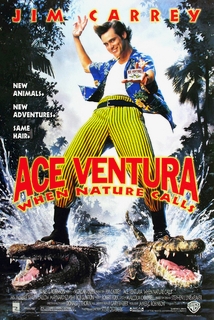
Behind the film
- Year
- 1995
- Director
- Steve Oedekerk
- Writers
- Steve Oedekerk, Jim Carrey
- Runtime
- 1h 34m
- Genres
- Comedy
- Production
- Warner Bros. Entertainment, Warner Bros. Pictures
- Country
- United States
- Cast
- Jim Carrey, Ian McNeice, Simon Callow, Maynard Eziashi, Bob Gunton, Sophie Okonedo, Tommy Davidson, Bruce Spence
About the film
Contains story spoilers.
Ace Ventura: When Nature Calls sends Jim Carrey's pet detective into an adventure that begins by parodying Cliffhanger and passes through Tibet before reaching Africa. The absent animal is the one creature Ace fears, so his professional confidence has an immediate weakness. Two tribes face war, and British officials want him to solve the disappearance before violence begins. The scale suggests an expedition, but the comedy keeps returning to Carrey's exaggerated movement and disregard for ordinary manners. A diplomatic reception offers another room to disrupt; the missing animal gives him a job, while almost every encounter gives him an excuse to turn the job into a performance.
Fulton Greenwall brings Ace to the fictional country of Nibia, where Shikaka, a sacred white bat, must be returned before a marriage can unite the Wachati and Wachootoo. Ace finds a feather at the bat's altar and investigates safari-club owner Burton Quinn. Darts fired at him, and a visit to the Wachootoo with Prince Ouda, complicate the trail. A difference between the darts finally points toward poachers holding Shikaka. Their attempt to dispose of Ace fails. The clues lead him to Vincent Cadby, the British official who hired him and secretly arranged the theft.
Cadby wants the tribes to fight so he can dominate the profitable guano trade. With the police protecting him, he has Ace arrested. Animals help Ace escape, Greenwall intervenes when Cadby tries to shoot him, and a monster-truck pursuit ends the official's getaway. Ace returns with Shikaka and stops the battle. Cadby flees into an encounter with an amorous gorilla. The wedding reveals that Ace has also slept with the princess; the tribes unite in chasing him. The detective can rescue an animal and expose corruption without acquiring the dignity that a more conventional adventure would award its hero.
Steve Oedekerk's partnership with Carrey began in stand-up comedy: he recalled meeting him at the Comedy Store in 1985, where their unusually strange acts brought them together. By the sequel, that affinity could support a film built around shared comic instincts. Oedekerk initially came aboard to polish the material and took over directing when the original director and star were not connecting comedically. He described their work as a friendly effort to outdo each other. That does not mean the camera simply caught whatever Carrey happened to invent. Asked specifically about improvisation in When Nature Calls, Oedekerk explained that Carrey prepared extensively, often brainstorming the previous night. Much of their ad-libbing happened before shooting rather than during a take. The apparent disorder therefore had a practical foundation in preparation. Carrey could keep looking for a funnier version, while Oedekerk encouraged actors to improve on the plan he brought to the set. Their collaboration helps explain why a sustained physical joke can take priority over moving briskly to the next clue.
The mechanical rhinoceros makes that approach especially tangible. Ace hides inside it while investigating Quinn, only for its cooling fan to fail and force him to squeeze out through the rear in view of safari tourists. The gag depends on an absurd object with recognisable physical constraints: a cramped hiding place, heat and an undignified escape route. The full-size exterior prop was more than ten feet long, constructed with a fibreglass body, a side hatch, hydraulic fittings and a removable latex rear sheet. Interior views were filmed separately on a soundstage. That division let the sequence combine the impression of an enormous animal outside with the discomfort of a man trapped inside. The surviving prop was later altered for display, with replacement neck and legs that no longer moved as the originals had. Its current condition should not be confused with its behaviour on screen. What matters to the scene is the transformation of apparently useful camouflage into a very public humiliation, performed through a physical object large enough to swallow the detective.
Oedekerk later connected the sequel's tone to an audience the first film had unexpectedly attracted. In a 2006 interview, he said the original Ace Ventura had been more sexually inappropriate for children than the filmmakers had anticipated when Carrey became popular with very young viewers. When making the second film, he deliberately reduced the amount of off-colour material because he knew parents would let children watch it. That aim still left room for grotesque slapstick, including the artificial-rhino escape discussed in the same interview. His adjustment concerned the kind of joke, rather than abandoning silliness. He described a persistent childlike part of his own comic imagination and a career that allowed different kinds of humour. The sequel's bodily excess sits within that declared attempt to think about its audience: embarrassment and physical absurdity could carry a scene even when he wanted fewer adult references. Its diplomatic-party disruption and elastic physical acting remain good examples of how thoroughly Carrey's performance sets the rhythm.