
Behind the film
- Year
- 1961
- Director
- Pier Paolo Pasolini
- Writers
- Pier Paolo Pasolini, Sergio Citti
- Genres
- Drama
- Country
- Italy
- Cast
- Franco Citti, Adriana Asti, Stefano D'Arrigo, Nino Russo, Franco Marucci, Polidor, Sergio Citti, Elsa Morante
About the film
Contains story spoilers.
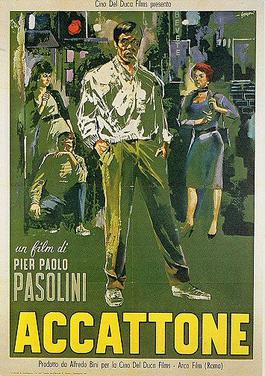
Accattone follows a pimp trying to survive in Rome's poor outer neighbourhoods. Pier Paolo Pasolini's first feature places Franco Citti among a largely nonprofessional cast, in a world of petty criminals and women whose prostitution supports the men around them. Maddalena is the woman Accattone exploits. When men from Naples beat her, the violence belongs to the same business that feeds him. Her imprisonment leaves him without that income. He later takes Stella out with his friends to show her the women working on the streets. His first intention is to turn her into another source of money.
Accattone tries returning to Ascenza, the estranged mother of his child, but her relatives reject him. He persuades Stella to sell sex; her first encounter ends in tears. His growing attachment leads him to try manual labour, which he abandons after one day. Maddalena, hearing in prison from Amore, another woman arrested for prostitution, about Stella, reports him. Under police surveillance and haunted by a dream of his death, he joins Balilla's gang in theft. Fleeing the police on a stolen motorcycle, he dies in a traffic accident. His last words to Cartagine express relief: he feels good now.
Pasolini wanted the camera trained on faces and the drama driven by violent reactions. That was how he described Accattone while making it, before its poverty and brutality had become a finished film. A contemporary newspaper report from the Pigneto set describes a small crew near Via Fanfulla da Lodi, an Arriflex camera on a tripod in a neighbourhood tavern and clusters of photographic lamps in place of large lighting rigs. A portable tape recorder stood nearby. The production had Alfredo Bini's backing after Fellini declined it. Pasolini explained his move into directing through dissatisfaction with films made from his scripts and a wish to represent this world more faithfully. Years later, Citti remembered being frightened at the first take, trying to conceal his shaking legs with a tough expression while Pasolini moved around him carrying the camera.
Cinematographer Tonino Delli Colli recalled that Pasolini arrived with definite ideas about images but little knowledge of the equipment needed to make them. Delli Colli had to explain the lenses when they began Accattone. Within weeks, he said, the director understood them and had settled happily on the 50mm lens: it kept the performers clear while making the backgrounds appear closer and more compressed. That concentration suited Pasolini. He would prepare the next day's shots the night before, then arrive knowing whether he wanted a full shot or another framing. Delli Colli's task was to turn his precise, sometimes intangible suggestions into photography. Their introduction had come through Flavio Mogherini, who mentioned Bini's project while working with Delli Colli on The Wonders of Aladdin. The cinematographer offered to take whatever fee the producer could afford.
The preparation also took the form of rough drawings beside action and dialogue. Surviving working sheets cover sixteen of the screenplay's seventy-eight scenes. On half-sheets of A4 paper, Pasolini sketched hurried figures in ballpoint pen, adding abbreviations for framing and occasional lens lengths. Delli Colli recalled that these breakdowns let him begin a sequence with its final shot. They still left room for changes during filming. The dream of Accattone's funeral developed beyond its drawn opening, while some written dialogue never reached the film. These were instructions for making scenes, with decisions about shots and cuts, rather than finished pictures of their own.
The black-and-white photography uses strong contrast and shifts between still extreme close-ups, small details and moving long shots. Faces can fill the image before the framing opens back out around the characters. Camera movement is kept economical, with some sequences allowed to continue without a cut. This treatment brings the people and their surroundings into a visual language connected to Renaissance painting and silent cinema. Pasolini identified Masaccio as the painter he consciously thought about during filming. He said his affinities with Dreyer, Mizoguchi and Chaplin became clear to him afterward, rather than serving as direct models he deliberately followed on set.
The voices and music also complicate the impression of everyday life simply being caught on camera. Pasolini later called having Citti dubbed a theoretical mistake, yet felt the replacement voice added something to the character. Dubbing, he argued, could enlarge a person and make him more mysterious, taking him beyond naturalism. The Bach accompaniment made a similarly deliberate meeting between the Roman underclass and an unexpected artistic language. Pasolini believed that combination had scandalised critics. He described Accattone's death dream as popular, mythical and rooted in beliefs older than bourgeois respectability. Even the final sign of the cross resisted an orthodox reading in his account: the reversed order of the shoulders made it a protective gesture, like a child's imperfect imitation, rather than a correctly performed Catholic ritual.