
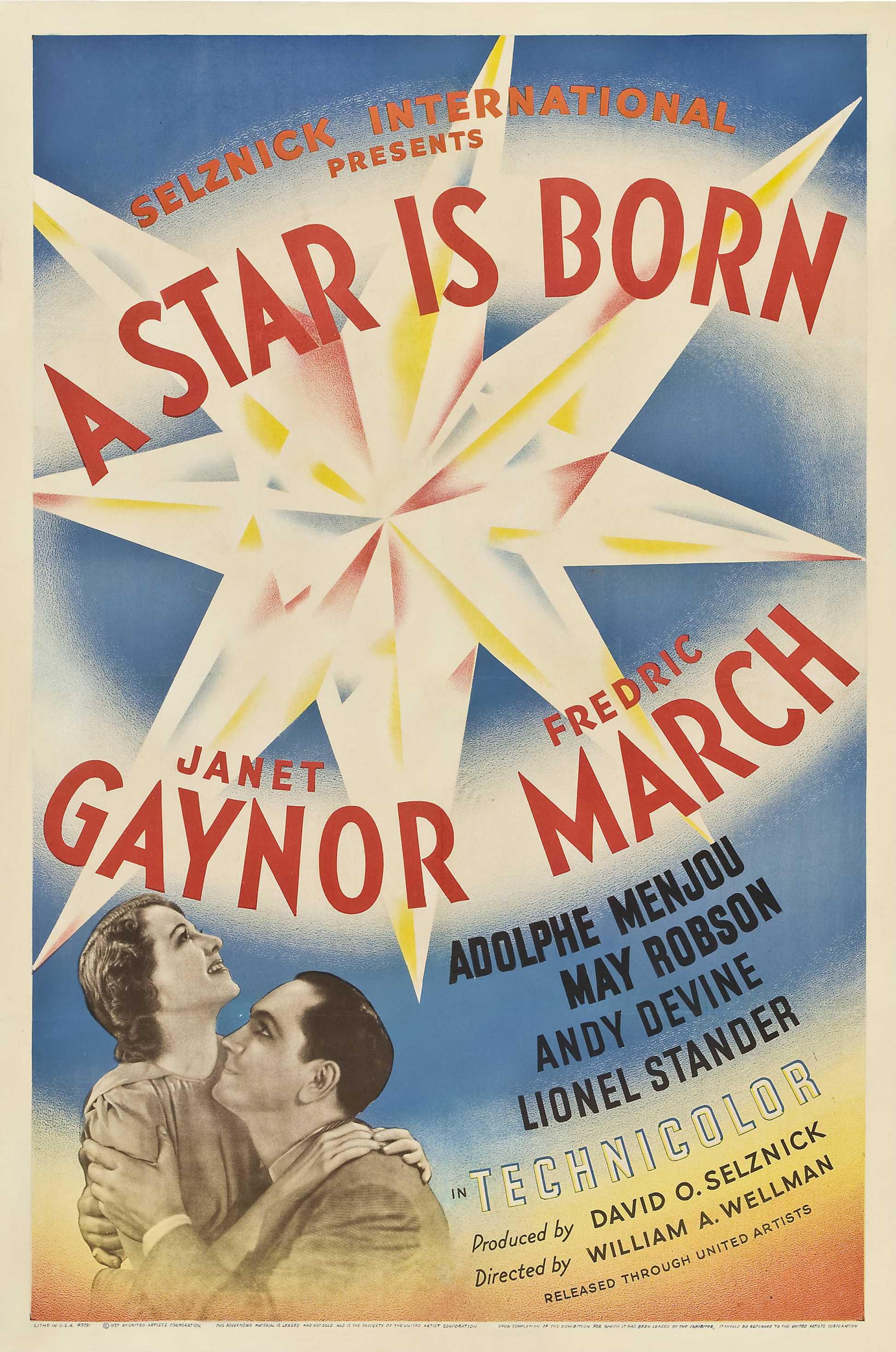
Behind the film
- Year
- 1937
- Director
- William A. Wellman, Jack Conway
- Writers
- Dorothy Parker, Alan Campbell, Robert Carson, Adela Rogers St. Johns, William A. Wellman
- Genres
- Drama, Romance, Musical
- Production
- Selznick International Pictures
- Country
- United States
- Cast
- Janet Gaynor, Fredric March, Adolphe Menjou, May Robson, Andy Devine, Lionel Stander, Owen Moore, Edgar Kennedy
About the film
Contains story spoilers, including the ending.
A Star Is Born begins with an ambition to act. Janet Gaynor's Esther Blodgett wants to work in the movies, and Fredric March's Norman Maine is the established actor she admires. The 1937 romantic drama follows her arrival in Los Angeles and their relationship as their careers move in opposite directions. William A. Wellman directs David O. Selznick's production, with a screenplay credited to Dorothy Parker, Alan Campbell and Robert Carson. Esther's rise gives the marriage its central difficulty: the work that brings her recognition is slipping away from her husband. Their private relationship must survive a public reversal of status.
Esther's grandmother gives her the money to leave home, but Hollywood has little room for another hopeful. Central Casting has stopped taking applications for extras. She meets Danny McGuire at her boarding house, and the unemployed assistant director becomes a friend. When Danny finds work, he helps her get a waitressing job at a Hollywood party. There she catches Norman's attention. He arranges a screen test with producer Oliver Niles, and Esther receives a contract and the professional name Vicki Lester. Norman then persuades Oliver to cast her opposite him in The Enchanted Hour. The picture makes Esther a success while audiences lose interest in her co-star. Norman promises to stop drinking, and the couple marry quietly, frustrating Matt Libby's plans to use the wedding for publicity. They travel in a trailer, taking their marriage away from Libby's intended publicity and crowds. Their honeymoon offers time away from the studio, but on their return the difference between their prospects becomes harder to ignore. When Esther wins the Academy Award for Best Actress, Norman interrupts her speech while drunk. His flailing gesture accidentally strikes her. The ceremony that should recognise her achievement becomes another public incident in his decline.
Treatment gives Norman a period of sobriety. Oliver offers him a supporting part, which he declines, and an encounter with Libby at Santa Anita sends him back to drinking. After an intoxicated car crash, Esther persuades the judge to release Norman into her care. At their Malibu house, he overhears her telling Oliver she intends to leave the movies to look after him. Norman asks for one last look at Esther, repeating his farewell on the night they met, before walking into the sea and drowning. His funeral brings another invasion of her private life: fans crowd around with little concern for her grief. Esther prepares to leave Hollywood, but her grandmother persuades her to stay. At a premiere outside Grauman's Chinese Theatre, she sees Norman's footprints and struggles to compose herself. She introduces herself over the radio as Mrs. Norman Maine. Lettie's encouragement recalls the support that first sent Esther to Hollywood. Esther returns to the public world under the name of the husband she has lost. The final screenplay page appears and the book closes, completing the frame that introduced her story as a shooting script. Her career continues, but that return follows a death it cannot undo.
The studio's control over Esther has a parallel in the film's own development. Wellman worked out the initial story with Robert Carson, while Selznick brought other writers into the screenplay. Parker and Campbell contributed dialogue, and the producer sent notes and revisions during production. Wellman also argued for Gaynor when Selznick favoured Merle Oberon. He had directed Gaynor in Small Town Girl and wanted the gentleness he associated with her performance. Both men wanted March as Norman. The casting places two experienced screen performers inside a story about the industry's appetite for a new face. Selznick requested three-strip Technicolor, and Wellman used recognisable Hollywood locations, including Grauman's Chinese Theatre, the Hollywood Bowl and Santa Anita. These places connect Esther's arrival, Norman's relapse and her final public appearance to the same city. The story keeps returning to spaces where people watch, judge or photograph them. Gaynor had received the first Academy Award for Best Actress. The colour photography also became part of the film's Academy recognition: W. Howard Greene received a special award, while Wellman and Carson won for Original Story. Their film's own awards history sits alongside its fictional ceremony, where professional recognition and personal humiliation occupy the same stage.
The film also survives in a dye-transfer print struck in 1946, which George Eastman House described for its 2015 Nitrate Picture Show. Daniel Selznick donated that copy in 1999. It retains a variable-density soundtrack, and the program identifies it as a probable theatrical re-release print. That physical copy carries the colour production into a later period of exhibition, rather than representing a newly made film. Surviving production material includes Gaynor's signed contract and a final shooting script, alongside a program for the Grauman's premiere. Selznick's papers at the Harry Ransom Center also include records of the production among the studio's script, publicity and distribution materials.