
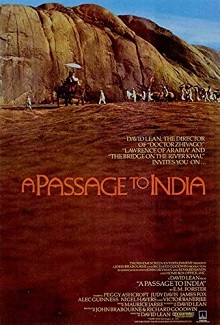
Behind the film
- Year
- 1984
- Director
- David Lean
- Writers
- David Lean, E. M. Forster
- Genres
- Drama
- Production
- Thorn EMI Plc, HBO
- Country
- United Kingdom, United States, Australia
- Cast
- Judy Davis, Victor Banerjee, Peggy Ashcroft, James Fox, Alec Guinness, Nigel Havers, Richard Wilson, Art Malik
About the film
Contains story spoilers.
A Passage to India begins with Adela Quested and Mrs. Moore visiting Ronny Heaslop in segregated Chandrapore. Moore befriends Dr. Aziz, while school superintendent Richard Fielding offers another connection across the division between British and Indian society. Getting these relationships onto the screen meant overcoming the novelist's resistance. Scott McGee's Turner Classic Movies account describes producer John Brabourne pursuing the rights from 1958. Forster feared that even a trustworthy filmmaker could lose control to others, and that an adaptation would become a one-sided argument for Britain or India. Changes at King's College, Cambridge, eventually cleared the way. Lean also wanted a different shape from Santha Rama Rau's draft, which he considered too confined to interiors. McGee describes six months of writing in New Delhi and three more in Zurich. Lean typed with two fingers, a slow method he said gave him time to consider where the story was going.
The financing discussions threatened more drastic changes. McGee records one executive proposing an explicit rape scene and another wanting Mrs. Moore removed to appeal to younger viewers. Those suggestions would have changed the cave mystery and eliminated the woman whose friendship first encourages Aziz. Funding eventually came through Columbia, Home Box Office and Thorn-EMI. Peggy Ashcroft initially resisted another lengthy Indian shoot after The Jewel in the Crown; James Fox became Fielding after Peter O'Toole declined. Lean's own additions were more closely tied to Adela. In Harlan Kennedy's 1985 Film Comment interview, he explained that he invented her bicycle ride to a temple with erotic carvings to suggest an awakening desire. Long views of a real temple were combined with constructed fragments filmed elsewhere. He did not know whether the separate pieces would join convincingly until he edited them. This was a deliberate alteration of Forster's characterisation, shaped around Lean's interpretation of her sexuality.
Aziz arranges the Marabar Caves excursion. Crowds and echoes overwhelm Moore; Adela later enters a cave alone and flees distressed. Back in Chandrapore, Aziz is jailed on an attempted-rape allegation. Fielding and Moore believe him innocent; Moore dies at sea while returning to England. The courtroom became another place where Lean changed the novel. He told Kennedy that he added Adela's admission that she did not love Ronny. He also described cutting between her spoken testimony and the cave, letting her voice continue across the change of time. His aim was to move through her recollection without confusing the audience. Moore's death was placed within the trial sequence so that her presence would hang over it. Elsewhere, the bridge party's social hierarchy was arranged physically: British guests sat above the Indians standing below. Lean worried that the cave echo might fail, because so much of the incident depended on it. These choices connect an uncertain private experience with the public arrangements surrounding the trial.
Adela retracts in court, freeing Aziz, and Fielding helps her after the British abandon her. Aziz moves to Kashmir. Fielding marries Moore's daughter Stella and later reconciles with him. Aziz writes to Adela, recognising her courage and asking forgiveness for his delayed appreciation. Aziz's changing manner posed a separate problem for Victor Banerjee. Speaking with Studs Terkel in 1985, the actor recalled discovering a different person in each scene and struggling to carry the initially Chaplinesque Aziz towards the self-defined Indian at the end. He proposed the gesture of applying surma to his eyes. The applicator brought out for the scene belonged to his grandfather. Banerjee credited Lean's huge close-up with helping the audience accept a transformation that could otherwise seem improbable. The actor's contribution made that change something Aziz does with his own hands, rather than leaving it entirely to dialogue. Banerjee also discussed Salman Rushdie's objection to the British viewpoint of Raj screen stories. He recognised the narrowness of that perspective while defending Lean against a sweeping dismissal of Indian cinema attributed to him. His account combines pride in his role with an argument over whose India the film presents.
Maurice Jarre's music developed alongside an edit still being finished. Interviewed by James Fitzpatrick for Soundtrack, the composer said he had received Lean's screenplay before shooting. He wanted an Indian flavour in the instrumentation while avoiding the familiar reliance on solo sitar. Fitzpatrick's accompanying account comes from attending the recording sessions at CTS in Wembley. He describes a five-week span beginning in early October, with roughly two full recording days each week. The musicians often had to wait for completed sections of film before music could be written and recorded; copyists sometimes prepared the manuscripts on the recording day itself. Fitzpatrick observed Lean and Jarre exchanging ideas, with Lean retaining the final decision and considering the producers' concerns about unfamiliar Indian sounds and the opening credits. The orchestra varied in size. A large percussion section, two ondes Martenot and Indian instruments supplemented the Royal Philharmonic, with Christopher Palmer assisting Jarre. That account places the score inside the practical pressure of completing particular scenes, from the composer's early response to the screenplay to recording music against newly edited passages.