
Behind the film
- Year
- 1987
- Director
- Chuck Russell
- Writers
- Wes Craven, Frank Darabont, Chuck Russell, Bruce Wagner
- Runtime
- 1h 32m
- Genres
- Horror, Teen, Drama, Slasher
- Production
- New Line Cinema, New Line Cinema's House of Horror
- Country
- United States
- Cast
- Heather Langenkamp, Laurence Fishburne, Craig Wasson, Patricia Arquette, Robert Englund, Jennifer Rubin, Bradley Gregg, John Saxon
About the film
Contains story spoilers, including the ending.
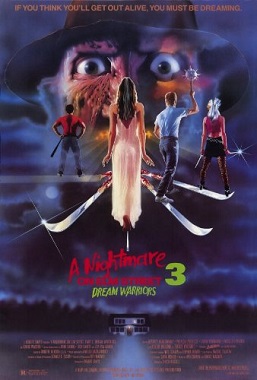
A Nightmare on Elm Street 3: Dream Warriors moves Freddy Krueger's attacks into a psychiatric hospital, where the people who most need to be believed are treated as patients in crisis. Patricia Arquette plays Kristen Parker, whose nightmare injuries are mistaken for a suicide attempt. At Westin Hills, she meets other teenagers facing the same killer and Heather Langenkamp's Nancy Thompson, now an intern therapist. Nancy recognises the nursery rhyme and the fear of sleep because she survived Freddy herself. That recognition gives the group an ally with practical knowledge of the threat. Kristen brings something new: she can draw other people into her dreams. The 1987 sequel turns that ability into the basis for collective resistance, letting patients share the place where they have previously been most isolated. Nancy's experience and Kristen's unusual power make their relationship the centre of the rescue effort.
Freddy's dream world gives each teenager a personal form of danger and a possible means of defence. Will can walk and become a wizard there, Taryn appears as a fighter carrying switchblades, and Kincaid has extraordinary strength. Their dream selves loosen restrictions imposed by their waking lives, but Freddy can still turn those lives against them. He attacks Taryn through the imagery of addiction, transforming his fingers into syringes, and the group cannot protect everyone by gathering together. Joey's capture leaves his body comatose, creating an immediate reason to return to the nightmares rather than simply trying to avoid sleep. The hospital setting adds another obstacle: treatments and sedation can put the teenagers precisely where the killer wants them. Nancy's effort to help therefore means challenging the official explanation of what is happening and organising a rescue in a world the institution cannot acknowledge.
The final battle runs along two paths. Nancy and the teenagers confront Freddy inside the shared dream while Dr. Neil Gordon and Nancy's father Donald search for the killer's bones in the waking world. Finding the remains does not make the burial simple, as Freddy animates his skeleton and attacks the men. Inside the dream, a figure appearing to be Donald approaches Nancy, only to reveal himself as Freddy and stab her. Nancy still manages to strike him with his own glove while Neil completes the burial with holy water and a crucifix. Freddy disappears, but Nancy dies from her wounds. The funeral adds another discovery when Neil finds that the nun who guided him was Amanda Krueger, Freddy's mother. Victory costs the group the adult who understood them most directly, rather than allowing the original survivor to lead everyone safely out and resume her work.
Chuck Russell directed the film, with a screenplay credited to Wes Craven, Bruce Wagner, Russell and Frank Darabont. Patricia Arquette's recollections bring its nightmare effects down to the practical experience of making them. Still early in her career, she was learning to hit marks and react to things that would be added afterwards. The enormous Freddy snake gave her a very different challenge: she spent hours inside the creature and recalled possibly falling asleep in its mouth between shots late at night. Some filming took place in a closed veterans hospital, where the young cast had cramped, rudimentary dressing rooms. Arquette remembered the actors signing one another's walls and gathering outside to talk about music. She also recalled Langenkamp's warmth toward the younger performers, a maternal presence despite their closeness in age. That offscreen companionship makes a useful counterpart to Nancy's place in the story, the person who can approach these frightened teenagers with understanding instead of disbelief.
The screenplay developed through distinct versions, and the differences help explain the balance between horror and fantasy in the finished film. Craven and Bruce Wagner devised the group of teenagers whose dream abilities let them resist Freddy together. Russell and Darabont then rewrote the material, adding scenes and changing characters. The original Craven and Wagner draft and the later rewrite survive separately, so details from the earlier script do not necessarily describe what appears on screen. Russell was more interested in expanding the imaginative possibilities, while Craven described his own conception as darker and expressed frustration with the changes. The shared dream remained the organising idea through that process. It gives Freddy opponents who can do more than run from him, but their powers do not remove his advantage. A hospital full of young people can become an ensemble adventure and still be a place where characters die.
Russell has described the adolescents as the heart of the film, with their growing awareness of danger shaping the dream imagery. That focus gives the extravagant effects a specific purpose. The nightmares grow from the personalities of the people trapped in them, and the adults' disbelief makes ordinary appeals for help unreliable. Nancy breaks that pattern because she knows the rules of Freddy's attacks, although knowing them does not guarantee her survival. The physical effects let the dreamscape keep changing around the performers, allowing an apparently recognisable space to develop its own threat. The closing image carries that instability into a much quieter setting. Neil goes to sleep with Kristen's small model house nearby, and a light appears inside it. The burial has ended the immediate confrontation, but the illuminated window prevents the last moments from offering certainty that Freddy has been permanently destroyed.