
Behind the film
- Year
- 2014
- Director
- Seth MacFarlane
- Writers
- Seth MacFarlane, Alec Sulkin, Wellesley Wild
- Genres
- Comedy, Western
- Production
- Universal Pictures
- Country
- United States
- Cast
- Charlize Theron, Amanda Seyfried, Liam Neeson, Giovanni Ribisi, Sarah Silverman, Neil Patrick Harris, Seth MacFarlane, Bill Maher
About the film
Contains story spoilers, including the ending.
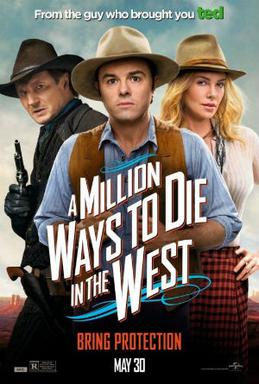
A Million Ways to Die in the West puts Seth MacFarlane's Albert Stark between a humiliating breakup and a much more dangerous romance. MacFarlane directs and stars in the 2014 Western comedy, with Amanda Seyfried as Louise, Neil Patrick Harris as her moustached new partner Foy, Charlize Theron as Anna and Liam Neeson as the outlaw Clinch. Albert initially wants to reverse Louise's decision to leave him. Anna's arrival gives him another person to talk to, and her help begins to change his prospects. The complication is that she is married to a man who responds to their attachment with violence. Albert's growing courage therefore has to survive a threat far beyond the romantic rivalry that first troubles him. The woman who helps him find his nerve also brings him within reach of a notorious gunman.
Old Stump, Arizona, in 1882 is home to a sheep farmer who would rather leave the frontier than become one of its celebrated gunfighters. Louise dumps Albert after he refuses a duel. Anna teaches him to shoot for a confrontation with Foy, but he eventually forfeits because he no longer thinks Louise is worth fighting for. Clinch's arrival exposes Anna's marriage and turns a public contest into a deadly demand. Albert's anger at being deceived complicates his feelings for her before he returns to confront her husband. After Clinch dies, Louise tries to reclaim Albert, who chooses Anna instead. He uses the bounty to buy more sheep. His reward keeps him connected to his ordinary occupation rather than sending him into a new life as a professional gunslinger. The romantic resolution changes whom he wants beside him without replacing the sheep farmer with an entirely different man.
Albert's explanation during the final showdown makes his survival depend on a trick rather than sudden mastery of the gun. He tells Clinch that he has put rattlesnake venom in a hollow-tip bullet. He admits that his aim was not good enough to hit an important part of the body, but says Anna taught him enough to land a shot by surprise. The speech returns to the many dangers Albert associates with the West, including disease and wild animals, and gives one of those dangers a place in his plan. Ruth interrupts to tell him that Clinch is already dead. Albert then wants to know whether his opponent heard the clever explanation. Edward's answer disappoints him. Even at the moment of victory, Albert is concerned with receiving credit for the thinking that allowed him to survive. The exchange keeps his anxious, talkative personality intact at the end of the gunfight.
Theron pursued the part of Anna because the combination of comedy and Western interested her before she had even read the material. She described the work as giving her room to try things while MacFarlane provided a clear foundation for the character. For MacFarlane, acting opposite her helped ease his uncertainty about becoming a live-action leading man. He found more connection with voice performance than he had expected, including the facial changes he already made while recording different characters. He also came to appreciate how much his performance depended on what his scene partner gave him. The New Mexico location brought less welcome surprises. Theron recalled receiving a warning from MacFarlane that the road was washing away and that she should leave her trailer. He described flash floods, extreme heat, cold winds and hail slowing the shoot. The landscape around their fictional frontier required the cast and crew to contend with rapidly changing real weather.
Joel McNeely approached the score as an earnest Western, following MacFarlane's instruction that the music should avoid commenting on the jokes. His orchestral reference points included Elmer Bernstein, Alfred Newman and Jerome Moross. The grand main title deliberately prepares the audience for a different kind of hero from Albert. McNeely also described holding the music back during the long fence scene between Albert and Anna, allowing the orchestra more freedom as the scene reaches their kiss. MacFarlane contributed specific suggestions about melody and harmony rather than limiting the discussion to a general mood. After a few mock-ups, he let McNeely concentrate on writing instead of repeatedly demonstrating the music in advance. The songs had their own changes of style. McNeely turned Stephen Foster's moustache song from its original triplet feel into a bluegrass arrangement in four beats. He and MacFarlane wrote the title song with the sound of 1960s country recordings in mind.
Editor Jeff Freeman described Albert and Anna's honest moments as the hardest part of balancing the romance with the broad comedy. Their confrontation after Albert learns the truth about her had to make the anger believable before moving into a joke. Freeman and MacFarlane refined the spaces between lines closely, with the director's sensitivity to sound shaping decisions about timing. MacFarlane could discuss Albert in the third person while editing his own performance, considering where the character needed to go emotionally. The work also involved effects beyond the obvious period setting. Freeman identified the bull striking a man, the falling ice block, cloud backgrounds and a dream sequence as effects tasks. His assistants helped prepare those elements in the editing system, while MacFarlane scrutinized details such as the clouds' appearance. Freeman said the director generally recognized when he had a performance and did not shoot large numbers of takes. The editing challenge was to keep the jokes moving while leaving Albert and Anna enough room to become a believable couple.