
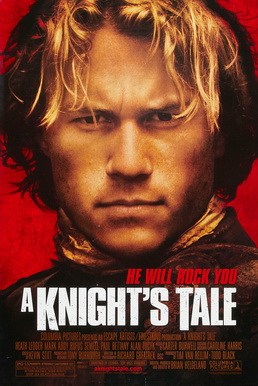
Behind the film
- Year
- 2001
- Director
- Brian Helgeland
- Writers
- Brian Helgeland
- Runtime
- 2h 12m
- Genres
- Action, Comedy, Romance, Knight
- Production
- Escape Artists, Columbia Pictures
- Country
- United States
- Cast
- Heath Ledger, Mark Addy, Rufus Sewell, Paul Bettany, Shannyn Sossamon, Alan Tudyk
About the film
Contains story spoilers.
Brian Helgeland sets the story in a medieval tournament circuit where a knight's name matters as much as his skill. William Thatcher, a squire, has spent years caring for Sir Ector and his equipment. When Ector dies just before the final pass of a competition, William sees a chance to escape his low station: he puts on the armour, rides the last joust and collects the prize. His friends Roland and Wat know the disguise cannot last, but William wants to enter more tournaments and persuade them to stay with him. In this world, only nobles are permitted to compete, so each victory raises the cost of the lie. William is not merely borrowing armour; he is trying to make a place for himself in a system that says the place is unavailable.
A chance meeting supplies the paperwork he lacks. The penniless Geoffrey Chaucer agrees to forge a patent of nobility, and William enters under the grand invented name Sir Ulrich von Liechtenstein of Gelderland. Chaucer's own troubles complicate the arrangement: he owes money to Simon the Summoner and Peter the Pardoner, and William insists on getting him released. He earns the money by winning the sword contest, then returns to jousting with a growing circle around him. Roland is cautious and practical, while Wat is quicker to celebrate a risky plan. Their partnership depends on keeping William's identity from the officials, but it also becomes a real friendship, so the disguise carries a moral debt alongside the danger of discovery.
In that first tournament under his invented name, William faces Sir Thomas Colville. He injures Colville, who asks to withdraw, but agrees to exchange a ceremonial pass so his opponent can preserve the honour of completing every match. William then reaches the final against Count Adhemar, an experienced rival who also wants the attention of Jocelyn, the noblewoman William has become infatuated with. Adhemar defeats him by knocking off his helmet and taunts him afterwards. William vows to beat him. At a banquet, the contest moves from horses to courtship: Adhemar tries to embarrass William in front of the guests, but William surprises the room with the dancing Kate has taught him. The blacksmith joins their travelling group and forges new, lighter armour.
At the next tournament, both William and Adhemar are scheduled to face Colville again. This time they learn before riding that Colville is Prince Edward, heir to the throne. Adhemar withdraws rather than risk hurting him; William chooses to ride against the prince and addresses him by name afterwards, earning Edward's respect. The two encounters establish an important distinction in how William treats an opponent. He accommodates an injured knight without knowing his rank, then allows a prince to compete rather than excluding him out of fear. Adhemar is called away to the Battle of Poitiers, and William wins several tournaments in his absence. His victories take him toward the London championship, where his rival will return.
Jocelyn tests William's idea of honour by asking him to lose a tournament in her name. He obeys, accepting the public cost rather than making the usual boast that a victory is for a lady. She then asks him to win after all, before he is eliminated, and he manages to return to the contest. The sequence makes their romance part of the sporting plot: Jocelyn is not simply a prize waiting at the finish, and William has to respond to her choices even when they are inconvenient. Their relationship is still built on a lie, though. Every public appearance as Ulrich requires William and his friends to maintain the invented pedigree, however much his ability in the lists now speaks for itself.
At the London championship, Adhemar has returned from war and is negotiating with Jocelyn's father to marry her. William visits his father, now blind, and the encounter recalls the boy who left home to squire for Sir Ector and try to change his prospects. Adhemar sees the visit and reports William's common birth to the authorities. His friends urge him to flee; Jocelyn offers to leave with him, but William chooses to enter the tournament. He is arrested and put in the pillory while the crowd turns against him. Edward steps forward, recognises the honour he has shown and knights him as Sir William, declaring the decision beyond challenge. In the final joust Adhemar uses a sharpened lance that pierces William's shoulder. Badly hurt and trailing by two passes, William has the armour removed and asks Wat to strap the lance to his arm. Chaucer buys time with the introduction he failed to give him earlier. William rides under his real name, knocks Adhemar from his horse and wins. His father and Jocelyn are present, and Chaucer says he will write down the events.
The film makes its medieval setting deliberately porous. Tournament crowds move to rock songs, and the public announcement of a competitor can feel like a modern sporting event, while armour, horses and the rules of the lists keep the stakes physical. These choices belong to Helgeland's comic adventure rather than to a claim of historical reconstruction. The jousts provide a repeated visual grammar: riders line up, lower lances, collide and return to the field, so the growing tension can be read in bodies and equipment before anyone explains it. The ensemble then keeps the story from becoming a string of matches. Bettany's Chaucer supplies flamboyant narration, Mark Addy's Roland counters William's ambition with caution, Alan Tudyk's Wat adds restless energy, and Kate's practical work makes the group's progress visible. The romance and the final recognition matter because they grow out of this travelling team and its shared risks.