
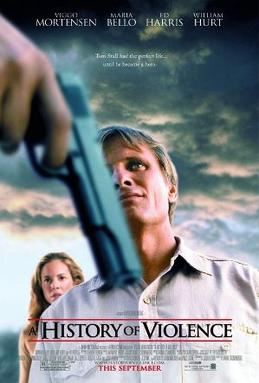
Behind the film
- Year
- 2005
- Director
- David Cronenberg
- Writers
- Josh Olson
- Runtime
- 1h 36m
- Genres
- Crime thriller, Drama, Action, Detective
- Production
- New Line Cinema
- Country
- Germany, United States
- Cast
- Viggo Mortensen, Maria Bello, Ed Harris, William Hurt, Ashton Holmes, Stephen McHattie, Greg Bryk, Kyle Schmid
About the film
Contains story spoilers, including the ending.
A History of Violence turns a familiar rescue into a question about the rescuer. Viggo Mortensen plays Tom Stall, a husband and father whose response to an armed robbery makes him a public hero. He saves people, but the speed and skill of the killings are difficult to square with the ordinary man everyone thinks they know. David Cronenberg's 2005 film builds its unease around that gap. Praise arrives before understanding, and the family man celebrated for defending his community soon has to explain why violence comes so readily to him. Maria Bello plays his wife Edie, while Ed Harris and William Hurt bring the criminal world into a story that begins inside a marriage. The danger is partly that Tom might lose his peaceful life, and partly that his family may discover they never understood the person at its centre.
The robbery has consequences that run through the Stall household. Tom lives in Millbrook, Indiana, with Edie and their two children, and the attention surrounding the diner makes privacy impossible. Carl Fogarty arrives convinced that Tom is Joey, a criminal with whom he has unfinished business. At school, Tom's son Jack is being bullied, and his eventual violent response gives the family's arguments an uncomfortable second front. A father publicly applauded for killing men now has to respond to his son's aggression. Cronenberg also gives the diner fight a distinctly physical cost: Tom uses a coffee pot, takes a knife wound in the foot and leaves the attackers horribly injured. The sequence is brief, but the bodies do not disappear into an abstract action scene. His competence protects the staff while exposing something that polite conversation and local goodwill cannot explain away.
Fogarty eventually brings the confrontation to Tom's home, using Jack as leverage to force him into a car. Tom attacks the men, but Fogarty shoots him and is about to finish the job when Jack kills Fogarty with a shotgun. The son has now entered the kind of violence his father wanted to keep outside their home. Tom's admission that he really is Joey Cusack gives the earlier denial a different weight. It was a sustained concealment from the people closest to him. The threat also extends beyond Fogarty: Tom travels to Philadelphia to meet his older brother Richie, whose welcome gives way to an attempt to have him killed. Tom survives the attack, kills Richie's men and shoots Richie. The visit removes an immediate source of danger, but it cannot perform the same clean solution on his marriage or erase what Jack has done.
The return to the family table makes the ending unusually difficult to settle. Tom comes home after the Philadelphia killings and joins Edie and the children at dinner. Small gestures allow him a place there, yet the silence leaves a great deal unspoken. The family is together in the same room; the film does not give them a conversation that establishes forgiveness or restores the old understanding. Edie's response matters because she has been forced to reconsider years of shared life. She can recognise the husband she loves while knowing that his account of himself was false. Jack has his own knowledge of his father's capacity for killing, and his own experience of using it. Dinner offers the possibility of continuing as a family without proving that continuation will be comfortable, honest or permanent. The final scene leaves that work with the people sitting at the table.
Cronenberg approached the material through the image of the friendly American small town and the genres that place danger inside it. The western and gangster film both supplied ways of thinking about the story: a man tries to live peacefully, then people who know his past arrive and force his old abilities into view. Casting Mortensen was central to making that premise credible. Cronenberg wanted someone who could belong to the town while combining a leading actor's presence with the subtlety of a character actor. Finding Edie meant finding a believable partner for that particular man, so the marriage could feel established before it was shaken. The director also asked for the sexual encounters to be added to the screenplay. They expose vulnerability and anger within the relationship, making the damage to the couple something expressed through their bodies as well as their arguments.
Josh Olson adapted the graphic novel by John Wagner and Vince Locke, but the film deliberately withholds much of the backstory the book supplies. The novel devotes a chapter to Tom's earlier life; the screen version offers fewer explanations for who Joey was or why he decided to become someone else. Richie also changes from a childhood friend in the book to Joey's brother, making the Philadelphia reckoning a family confrontation. Edie's position is less reassuring on screen: the novel keeps her feelings steady, while the film leaves the marriage uncertain. Another consequential change gives Jack the killing that saves Tom, an act performed by Edie in the book. These choices bring the consequences closer to the children and leave less room for a complete explanation of their father. The Indiana town itself was filmed in Ontario, with Millbrook providing its small-town setting.