
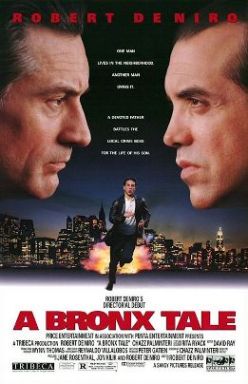
Behind the film
- Year
- 1993
- Director
- Robert De Niro
- Writers
- Chazz Palminteri
- Genres
- Coming-of-age, Drama, Crime, Crime thriller
- Production
- TriBeCa Productions
- Country
- United States
- Cast
- Robert De Niro, Chazz Palminteri, Lillo Brancato, Taral Hicks, Francis Capra, Kathrine Narducci, Joe Pesci, Tony Sirico
About the film
Contains story spoilers, including the ending.
A Bronx Tale follows Calogero Anello from childhood into adolescence in a neighbourhood where the local gangster attracts more attention than the men who work for a living. At nine, Calogero sees Sonny kill a man during a street dispute and refuses to identify him to police. Sonny takes an interest in the boy, while Calogero's father Lorenzo objects to their friendship and returns the money his son has earned at the gangster's dice games. Years later, Sonny pulls Calogero out of a car before his friends launch a racist attack that ends in their deaths. Calogero survives, but Sonny is then killed by the son of his earlier victim. At the funeral, Carmine reveals that Sonny saved his life in the original confrontation. Lorenzo recognises Sonny's care for Calogero, and father and son leave together. The two men's influence has carried consequences that Calogero must now understand for himself.
The conflict between Lorenzo and Sonny gives the crime story the shape of a fable about growing up. In his contemporary TIME review, Richard Schickel emphasised the reflective tone and the attraction Sonny holds for a boy watching his father's ordinary working life. The adults offer competing lessons, but the ending brings their concern for Calogero into closer agreement. His relationship with Jane gives him another reason to question the assumptions around him. What initially looks like a choice between two older men becomes a question of how he will live among other people.
The passage from 1960 to 1968 changes the pressures on Calogero. Francis Capra plays him as a child, and Lillo Brancato takes over as the teenager who falls in love with Jane, played by Taral Hicks. His friends' racism makes that relationship a test of loyalties within the neighbourhood. Sonny encourages him away from their behaviour, even though the gangster's own power depends on violence. Time Out's review found that portrayal too virtuous, while praising Palminteri's charisma and the energy of the younger performers. The review also singled out the music, faces and speech rhythms as strengths of the earlier section. Those details give the neighbourhood a social life beyond the central argument over Calogero's future. Its familiar voices and public encounters help explain why leaving the group's assumptions behind is difficult, even when he can see the harm they cause.
Chazz Palminteri wrote the screenplay from his one-man play and kept the role of Sonny. In a 1993 interview, he explained that he had performed eighteen characters on stage. The film allowed some of that narration to become visible action, particularly at the racetrack and in the fighting and boxing material. Other scenes carried over directly from the play. De Niro repeatedly asked him to try alternatives and rewrite, eventually bringing selected changes back into the original draft. Palminteri's involvement extended well beyond delivering a script and appearing in front of the camera. He recalled being included in casting and location decisions, then asked to remain for editing and the final sound mix when he had expected to return to Los Angeles. The story also carried something specific from his father, who had worked for the bus company and trained fighters. Palminteri remembered him warning against wasted talent after a promising young fighter died of an overdose. His father put that thought on a card in his room, where it became an everyday reminder of what he hoped to do.
De Niro's first feature as director depended on finding people who could inhabit that setting convincingly. In Interview magazine, he recalled asking casting director Ellen Chenoweth to search streets and local communities long before filming rather than begin with the usual agency calls. Newspaper and radio advertisements kept the search going. He wanted performers with an instinct for the world of the story, including people whose awkwardness might help rather than spoil a scene. Marco Greco supplied tapes of local people, and the search extended beyond New York to other cities. Brancato was found at Jones Beach, while Capra and Hicks came through open calls. Eddie Mush was played by the man on whom the character was based. De Niro had promised Sonny to Palminteri and chose Lorenzo for himself, partly to help the production and partly because the father's position interested him as a parent. Playing the working father also gave him a different part from the gangster audiences might have expected. He described Palminteri's continuing presence as useful whenever a scene needed shortening or reworking.
That search for believable behaviour continued after filming. Julia Reed's Vogue profile observed De Niro working on repeated dialogue in a sound booth, adjusting delivery while the actors watched the filmed scene. A short line could occupy a long session as he tried different emphasis, duration and force. De Niro explained that small changes of inflection carried different meanings within this particular social world. His attention to sound made the characters' speech part of their relationships: an apparently casual phrase still needed the right intention behind it.