
Behind the film
- Year
- 1982
- Director
- Walter Hill
- Writers
- Roger Spottiswoode, Walter Hill, Steven E. de Souza, Jeb Stuart, Larry Gross
- Genres
- Action, Buddy, Thriller, Comedy
- Production
- Paramount Pictures
- Country
- United States
- Cast
- Nick Nolte, Eddie Murphy, Annette O'Toole, Frank McRae, James Remar, David Patrick Kelly, Sonny Landham, Brion James
About the film
Contains story spoilers, including the ending.
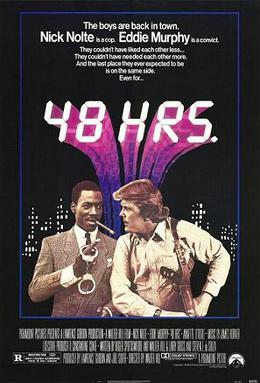
48 Hrs. puts a San Francisco policeman and a prisoner together because the policeman needs knowledge he cannot get elsewhere. Nick Nolte plays Jack Cates, who survives a hotel confrontation in which two fellow officers are killed and his gun is stolen. The killers are Albert Ganz and Billy Bear, fugitives searching for money from an earlier robbery. Eddie Murphy plays Reggie Hammond, a member of their old gang who still has six months of his sentence to serve. Jack gets him out for forty-eight hours to help track the men down. Walter Hill's 1982 film makes the deadline a limit on an already unstable arrangement. Jack expects obedience; Reggie has information, money at stake and plans of his own. They can move through the same city together without agreeing about whose business comes first.
The concealed money explains why Reggie is never simply Jack's assistant. Half a million dollars taken from a drug dealer is hidden in his car, and Ganz wants to reach it. Another former gang member, Luther Kelly, is being forced to retrieve it because the fugitives have taken his girlfriend Rosalie hostage. Jack and Reggie follow Luther through a city where each lead can turn into another escape. Their own conflict becomes physical when an argument erupts into a fistfight. Later, Jack apologises for his insults, but the investigation still goes badly: Ganz kills Luther, and a pursuit of the fugitives' stolen bus ends with Jack's car wrecked. Captain Haden blames Jack, who now defends the prisoner he had been treating with contempt. Their ability to recognise each other's usefulness develops while the case keeps slipping away from them.
The last pursuit begins with a guess about where a fugitive might go when he needs somewhere familiar to hide. Jack and Reggie return to the girlfriends' apartment in Chinatown and find the men they have been chasing. Reggie kills Billy Bear, while Ganz escapes with the cash and takes Reggie hostage during the pursuit outside. Jack shoots Ganz, freeing Reggie, and kills him when he charges. Afterward, the money goes back into Reggie's car to await his release, and Jack asks about a loan toward a replacement car. Their last exchange returns to something much smaller than the stolen fortune. Reggie has lifted Jack's lighter, and Jack asks for it back. A warning about future crime becomes part of their banter. The case is over, but Reggie remains a thief who must finish his sentence and Jack remains the policeman watching him.
Reggie's performance at Torchy's bar gives their uneasy arrangement a different balance. With Jack's badge, he takes on the authority of a policeman in a room where the white patrons do not expect him to command them. The questioning becomes a display of confidence, threats and control, while Jack has to watch the man in his custody handle the encounter. Hill remembered shooting the sequence with screenwriter Larry Gross beside him and realising that Murphy was doing something unusually entertaining. That recollection belongs to a scene in which Reggie briefly determines the terms instead of accepting Jack's. The borrowed authority serves the search for Billy Bear, but it also gives the prisoner space to perform a role Jack usually reserves for himself. Murphy's bravado turns their practical need for information into a contest over who can work the room.
The pairing took shape after several different casting possibilities. In an earlier version, Clint Eastwood was considered for the prisoner, rather than the cop; Hill felt that casting him as the officer would bring the film too close to Dirty Harry. Richard Pryor was suggested later. Once Nolte was attached, Gregory Hines was wanted for the other role but had a Broadway commitment. Murphy's agent then proposed looking at tapes of the Saturday Night Live performer. Hill met Murphy and warned Nolte about the challenge of working opposite someone talented but untrained: Nolte would need to be ready in every take because the take where Murphy succeeded would be the one used. Hill credited Nolte's generosity toward his new colleague. The experienced actor's consistency and the newcomer's energy had to fit together in individual scenes before the whole partnership could work.
Hill described Jack and Reggie's relationship as an anti-buddy story. He meant their hostility seriously: shared danger tests their characters and produces guarded respect, while each still understands that they are heading toward a different life. His description gives the goodbye a wistfulness beneath its jokes. The men have learned enough about one another to act together, but the temporary release cannot turn into permanent freedom for Reggie. Hill also stressed the actors' part in making that farewell work, and counted it among his favourite scenes. For a film driven by pursuit and gunfire, the ending depends on the smaller adjustment between two people who began by denying they had anything in common. Their circumstances still divide them, though the experience has changed how they speak and what they are prepared to recognise in each other.