
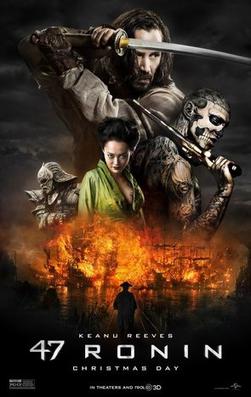
Behind the film
- Year
- 2013
- Director
- Carl Rinsch
- Writers
- Hossein Amini, Chris Morgan
- Genres
- Action, Fantasy, Adventure, Drama
- Production
- Universal Pictures, Moving Picture Company, Village Roadshow Pictures
- Country
- United States
- Cast
- Keanu Reeves, Hiroyuki Sanada, Jin Akanishi, Rinko Kikuchi, Tadanobu Asano, Kajioka Junichi, Yorick van Wageningen, Togo Igawa
About the film
Contains story spoilers, including the ending.
47 Ronin places Keanu Reeves' Kai beside Hiroyuki Sanada's Oishi in a samurai fantasy about the fall of the house of Asano. Kai grew up among supernatural Tengu before Lord Asano took him in. His mixed ancestry leaves him rejected in Ako, where he loves Asano's daughter, Mika, played by Ko Shibasaki. Tadanobu Asano plays Lord Kira, whose desire to possess Mika and her province brings Rinko Kikuchi's shapeshifting witch into their lives.
The witch makes Asano believe Kira is assaulting Mika. His attack on the unarmed lord brings a sentence of seppuku. The Shogun gives Kira Ako and orders Mika to marry him after a year of mourning. Oishi is imprisoned; Kai is enslaved. Released nearly a year later, Oishi gathers the scattered ronin and rescues Kai from Dejima's fighting pits. Kai leads them to the Tengu for swords. Oishi must resist an illusion of his son's slaughter without drawing his weapon, while Kai faces his former master. Armed, the men attempt an ambush, but Kira's procession is a trap. Survivors enter his castle as wedding performers and scale its walls. Oishi kills Kira; Kai defeats the witch in dragon form and saves Mika. Their revenge breaks the Shogun's prohibition. He restores their honour and allows seppuku, but pardons Oishi's son, Chikara, to continue his bloodline. Mika receives Ako and mourns Kai, remembering his promise to find her across other lives. Revenge restores the household while costing the lovers their future together.
Sanada told MANTANWEB that he initially questioned why Hollywood wanted to make Chushingura and whether Japanese viewers would accept it. A meeting with director Carl Rinsch changed his mind. The revised script and visual designs went further into fantasy than he had expected, which he felt could make the story accessible across cultures and ages. His condition was that its underlying loyalty and samurai customs should survive those changes. He also insisted on Japanese performers for the Japanese roles, a position he said Rinsch shared and the producers guaranteed. Sanada described repeated discussions with Reeves, Rinsch and the writers, pointing out details that felt wrong in a Japanese context. He wanted gestures to carry meaning where dialogue was unnecessary, keeping the expression restrained rather than spelling everything out. Rehearsals supplied further ideas, and the script continued changing until the day before filming began. His account puts the actor's work into the decisions about how these people behave, as well as how Oishi fights. Fantasy gave the filmmakers freedom, but Sanada still wanted their customs and loyalties to be recognisable.
Rinsch described the relationship between history and invention during the production's Shepperton set visit. He distinguished the historical revenge from Chushingura, the tradition of retelling it in different forms. That distinction let him approach the material as a samurai fantasy, drawing upon Japanese creatures unfamiliar to him rather than treating every departure as forbidden. He wanted large physical sets and costumes alongside digital environments, creatures and fights. His emotional route into Oishi's revenge was to imagine losing a father: the lord's death needed to register as a personal loss. He also wanted audiences to understand that killing Kira would carry a price, so the final surrender would follow from the men's decision. For the 3D, Rinsch compared changes in depth to musical variation. He wanted stronger passages followed by quieter ones, allowing the effect to build again instead of remaining at the same intensity. The size of the cameras also limited handheld movement. He described returning to classical camera methods, with traditionally styled lighting helping give the digitally photographed world the romantic feeling he sought.
Set designer Masako Masuda described a more practical difficulty in joining those physical and digital worlds. Her art department designed the sets in Los Angeles for construction and filming in London and Budapest. She was impressed by photographs showing how the Budapest builders had carried out those designs. In her Pushing Pixels interview, she recalled discovering that another team had altered one of her sets to accommodate computer-generated action without telling her. Moving an alcove, screen or other feature affected choices she had made for architectural and story reasons. The other team was arranging the space around its action requirements. Masuda said she could have adjusted her design if she had known the problem, letting both departments work more efficiently. Her example concerns the layout of a particular environment: the space had to serve the scene while remaining coherent as a designed place. She wanted closer communication between the departments making it.
Reeves described Kai's wish to belong in the production notes. He saw a recognisable immigrant story in someone seeking acceptance while keeping his individuality. He had worked on the screenplay with Chris Morgan and Hossein Amini before meeting Rinsch. That involvement connects the invented outsider to the film's central relationships: the rejected fighter becomes someone Oishi needs, while his love for Mika remains constrained by her position and the customs of their household.