
Keep a Small Farm Working Through Each Season
On this page
A Small Farm starts with accessible Fertile Soil and a blueprint you have already obtained. Having soil alone does not guarantee the building choice. This guide covers ordinary PC base-game settlements on Settler through Viceroy, without special map modifiers that alter the seasonal routine. Farming prerequisites
Place the building around usable fields
Preview the farm near your soil patch and check its working radius. Build Farm Fields on the fertile tiles within reach. Prefer adjacent non-fertile ground for the building when the layout allows, so you preserve more useful plots. Field placement
Make sure construction finishes before expecting farmers to work. The Small Farm has two worker slots; that is its capacity, not a requirement to fill both before it can operate. Small Farm
Check the season before relying on this new food supply. A farm completed in Clearance with nothing planted cannot solve an immediate shortage through a fresh planting that season. Keep another working food source available while you wait for the farming cycle.
Choose a crop you can use
The Small Farm can grow grain and vegetables. Grain needs further processing and cannot be eaten raw; vegetables are raw food. Grain, Vegetables
Before Drizzle, check the farm’s enabled crop choices. If you need an edible harvest and lack a working grain food chain, vegetables have an immediate purpose. If you choose grain, open its intended processing building and check the recipe, other ingredients and workers. A blueprint you hope to receive later is not a functioning food chain.
Choose around your present needs instead of declaring one crop best everywhere. When both are allowed, observe what actually gets planted before planning around a particular split.
Match your workers to the season
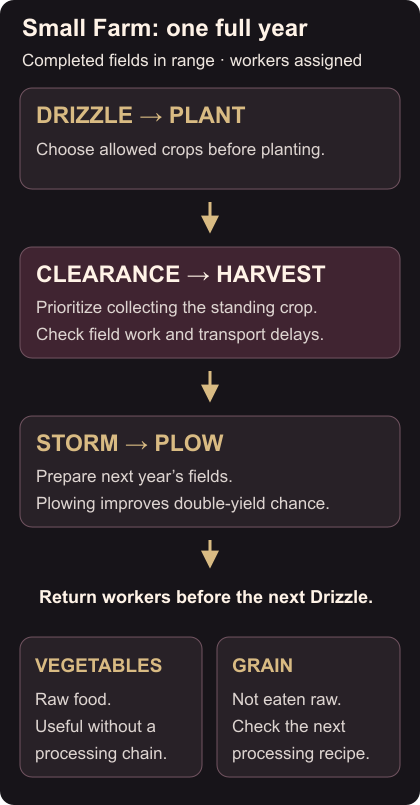
During Drizzle, farmers plant. During Clearance, they harvest. During the Storm, they plow, improving the chance of a double yield on the next crop. Seasonal farm work
In Drizzle, watch how much of the patch gets planted. Avoid removing farmers while unfinished plots still need work. If you temporarily move them after planting finishes, restore them in time for Clearance.
During Clearance, prioritize the harvest and inspect what workers are doing. Are crops still standing while everyone is busy, or is a farmer making long trips? If a large patch exceeds the workers you have available, consider another nearby farm with additional slots. Putting more people into an already full building is not an option.
If transport is slowing things down, review warehouse placement. Current hauler controls also let you prioritize farms, but a farm must remain inside a warehouse’s hauling range; a high priority does not remove that limit. Developer hauling update
In the Storm, let farmers plow the fields you intend to use next year. Reassign them when their useful field work finishes, then put them back before Drizzle. Treat this season as preparation rather than a fresh harvest.
Diagnose the missing food
At the next year, separate three problems: plots never planted, crops not harvested, or grain with no working food processing. Each points to a different correction; adding another farm does not automatically fix all three.
Use production limits and ingredient controls when harvested crops disappear into unwanted recipes. For the other worker changes needed during bad weather, follow the storm hostility guide.