
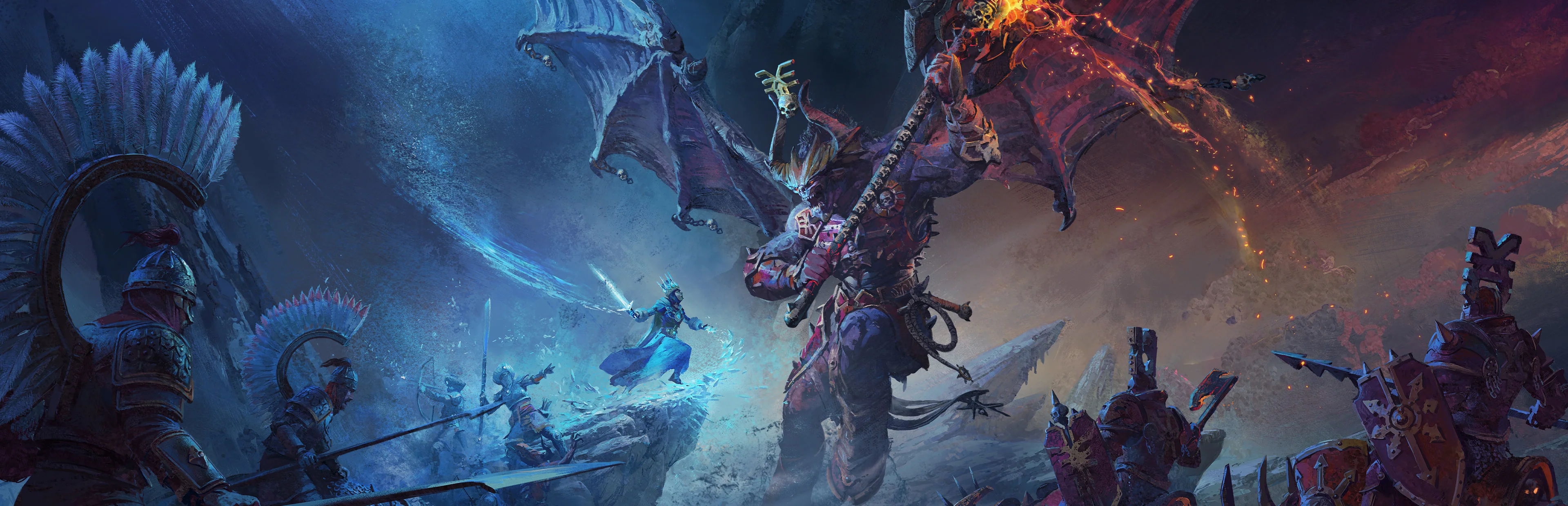
About Total War: WARHAMMER III
Creative Assembly's third Warhammer game is also the entry point for the trilogy's whole roster, which makes the ownership rules part of the review rather than a footnote.
The two layers, and why they need each other
On the campaign map you are managing settlements, recruitment and the economy that pays for it, and the interesting failure state is not losing a battle but arriving at one with the wrong army. On the battlefield the same units become a real-time problem of positioning, matchups and morale, where a big monster is only as good as the flank it is standing on.
The relationship between those two layers is the series' foundation rather than a WARHAMMER invention, but the factions here are deliberately asymmetric, and that is what makes each campaign read differently. A roster built around monsters solves problems that a roster built around artillery does not, and the campaign layer has to support a different set of answers for each of them.
The decisions underneath are concrete. On the battlefield a unit is only as reliable as its leadership: a formation that takes a charge in the flank or the rear breaks far sooner than one holding a line, and the studio's own patch notes hand out attributes such as Devastating Flanker and describe units fleeing once they have had enough. Where a unit stands, and what it is standing next to, is a decision rather than a detail. The campaign layer is where that army is paid for and recruited, which is why arriving at a battle with the wrong composition is worse than losing one you had a chance in.
Seven races, ten lords, one narrative campaign
The base game's own pitch is the last roar of a dying god and a portal to the Realm of Chaos, with the four Ruinous Powers spilling out and Kislev and Grand Cathay standing against them. That is seven playable races and hundreds of units, with ten Legendary Lords to choose from, including the Daemon Prince, whose customisation is advertised with a suite of body parts and powers that Creative Assembly describes in terms of billions of combinations. It is the most overtly role-playing thing the series has done with a faction: your daemon is assembled rather than selected.
Immortal Empires: access is not ownership
The thing buyers ask about first is the trilogy-spanning sandbox campaign, and the store listing answers it directly. Immortal Empires combines the campaign maps, races and factions from all three games into one campaign, and the note attached to that listing, as it stands today, says all owners of WARHAMMER III can access it. The second half of the note is the part that gets missed: several of the races available inside Immortal Empires are unlocked only if you own WARHAMMER, WARHAMMER II or downloadable content across the trilogy.
The access model has also loosened over time. When the Tides of Torment content landed alongside patch 7.0, the studio's own announcement said Immortal Empires was unlocked for owners of the first two games as well. So the accurate way to think about it is that access to the campaign is broad while the roster you can actually play is a function of what you own. Buying WARHAMMER III gets you through the door; the armies behind the door are the trilogy you have collected.
Multiplayer is bigger than it sounds
The base game ships with more than a duel mode. There is an eight-player Realm of Chaos multiplayer campaign, which is the sort of feature that only exists because the campaign and battle layers were built to be played by more than one person at once. Alongside it are story-driven multiplayer campaigns built around Kislev and Grand Cathay, a 1v1 Domination mode, and ranked and custom battles. For a game that people mostly play alone, the co-operative campaign is the part worth flagging to friends.
Where the content line stands now
The value question with any Total War game is where the content line currently sits, and it is long, so the short version is better than an inventory. The base game is a complete strategy game with its own narrative campaign, and everything sold since then is a menu of factions, lords and characters rather than missing chapters. If you are the kind of player who wants every lord, the collection bundle exists and includes the whole line to date. The next pack, Lords of the End Times, brings Nagash, Thanquol, Boris Todbringer and the Glottkin alongside a game update and a free legendary lord, and it was still listed as a pre-purchase when we read the store entry, so treat it as announced rather than shipped.
Platforms and size
The store entry used here supports Windows, macOS and SteamOS with Linux, and it credits Creative Assembly and Feral Interactive as the developers, with Feral's own catalogue being a Mac and Linux operation rather than a console one. The listed minimum is 120GB of storage, which is the number to look at before buying anything, and the store notes that paid and free content may raise the requirement over time.
Should you play it
Yes, if you want a strategy game where the campaign and the battle are genuinely the same game rather than a board and a minigame. The faction asymmetry is the strongest argument for the trilogy, and WARHAMMER III is where the most varied rosters in it live.
Skip it if you want a clean, single-purchase roster, because the ownership rules are part of the design and the answer to what you can play is a list rather than a game. Skip it as well if a large install and a long campaign are not what you have room for right now.