
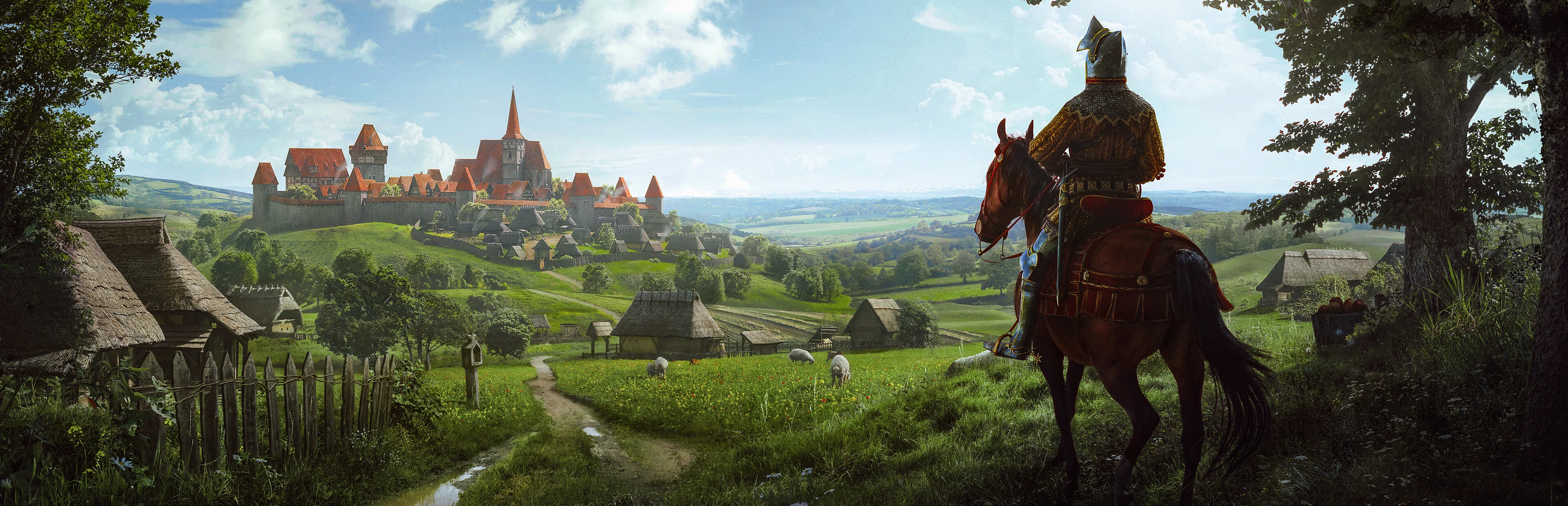
About Manor Lords
Every building is paid for by the people who staff it, which is why the interesting decisions here are about who is doing what rather than where the wall goes.
The market square sets the pace
The layout of the game follows the growth of real medieval settlements. You place buildings freely on a gridless map, and the residential, commercial and industrial areas are meant to follow the land rather than a template. Farms go where the soil fertility is, hunting grounds go where the animals are, and the raw materials your settlement needs force you to look at where the deposits and the forests actually sit.
Housing is the part that makes it feel different from its neighbours, and it is worth being precise about who is deciding what. You draw the burgage plot and you lay the roads, and the plot is subdivided to fill the space you allotted, so house size is an outcome of your street plan rather than a building you drop from a menu. Larger homes then take extensions at the back, and those extensions are production: the studio's own description has homeowners growing vegetables, raising chickens and keeping goats, supplying themselves and their neighbours with things your managed farms and pastures cannot cover.
The market is the other half of that, and it does not scale on its own. A market's supply is capped by the number of stalls attached to it, and each stall is built and stocked by a family working out of a granary or storehouse, so a town that keeps growing eventually needs more storage families committed to feeding the square. The market panel tells you when a region has hit that ceiling, and the fix is a staffing decision rather than a bigger building.
Workforce and oxen are the real currency
The most recent major update pushed the logistics layer much further. A Construction Yard stores construction material and distributes it to building sites by handcart, builds 50% faster when it is properly maintained, and is also what unlocks advanced construction: heavier structures need professional builders assigned to the yard, while unassigned families still help with transport and basic tasks such as flattening the ground. It converts a building you could ignore into a staffing decision with a visible cost.
Oxen are the other half of that story. Assigned to the yard they use an ox cart and move timber in bulk, which is the difference between a village that can build and a village that can only queue. Then there are jobs that quietly change shape with the year: work areas limit where gatherers can go, Trading Post storage filters decide what a post will import, and exporting traders look for the closest available post in the chosen region rather than the one built first. If you enjoy route-planning games, this is closer to one than the screenshots suggest.
The year is the schedule
Seasons are not decoration. The studio's own summary of the loop is about enjoying what the spring rains bring and preparing for the harsh snows, and the way that plays out in the economy is through food. Pasture animals get hungry over winter and have to be fed, or they die, with the feed crafted from oats at a livestock farm. Breeding is seasonal and tied to herd size: cows breed in summer and sheep in autumn, with the offspring arriving in spring. Sheep are sheared once a year in summer, cows are milked monthly apart from winter, and apiaries accumulate through spring and summer only to be harvested in autumn.
That combination turns autumn into the most important planning season of the year, because it is the last chance to bank what you will need when nothing is growing. Our read is that the game is at its best here: the winter is not a random event, it is a deadline you set yourself by how much pasture you built in the spring, and every extra cow is a mouth you have promised to feed.
What an army costs the village
The military layer is built the same way, as a question about your people rather than a separate mode. You raise a town militia from the settlement, train a retinue of professional soldiers to fight beside them, and hire mercenaries when you need numbers quickly and can pay for them. The three are not the same resource: the militia are drawn from the families who would otherwise be working, while the retinue and any hired bands are paid for out of your own wealth, and the game's own framing of the trade-off is that calling up levies costs you production at home in a way that a hired sword does not.
Battles play out in real time with fatigue, weather and equipment taken into account, and the listing makes a promise that matters more than the swordplay: a smaller force can beat a larger one if it is handled well, and losses are not abstract numbers. Every soldier you lose was somebody, whether that somebody was a family pulled off a workshop or a professional you paid to be there. That is about as clean a statement of consequence as a strategy game can make.
Read the Early Access note before you buy
Manor Lords is still in Early Access, and the developer's own answers to the store's Early Access questions should be taken at face value. There is no set date for leaving Early Access, the plan is to add content shaped by feedback during it, and the money note is explicit: the price may go up as content and features are added. On the other side of the ledger, the developer states that the version on sale contains the full set of content and features described on the store page, including the city building, the resource management and the battles, and that the structure and major mechanics are already in place.
What that means in practice is a game that is genuinely playable and still moving. The team has been shipping large updates, including new maps, new animals and crops, seasonal systems and a long list of fixes to trade and hauling. It started as a solo developer's project and grew into a small studio, which shows in the simulation's ambition and occasionally in how much of it is still settling down.
Should you play it
Yes, if you like colony games where the pressure comes from labour rather than enemies, and you would rather plan a street layout that produces good housing than place a building that says it produces housing. The seasonal food economy and the ox-cart logistics give the village a pulse that most medieval builders do not have.
Skip it if you want a finished, balanced, feature-complete strategy game right now, because this one tells you plainly that it is not that yet. Skip it too if you want a game that holds your hand through the first two hours, because the economy here punishes a bad staffing decision several seasons after you made it.