
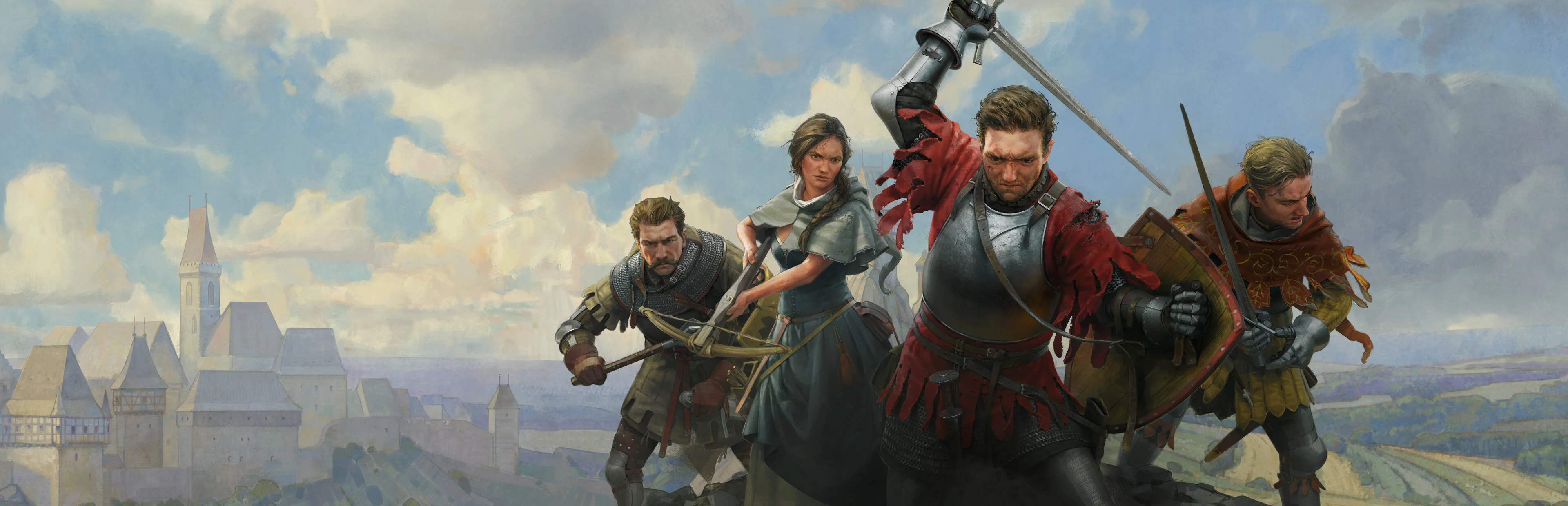
About Kingdom Come: Deliverance II
Warhorse Studios built a sequel that doubles down on the first game's central idea: nothing about Henry improves because you were present for it.
Skills level by doing, not by spending
The studio's own description of progression is that Henry's skills level up as they are used, reflecting the choices you actually make. Weapons, stealth, blacksmithing and alchemy are called out as the tracks, and improving one of them improves related abilities too. Using a skill is not the only way up, though. Progress also arrives through learning from teachers and through finishing quests, and skill books sit on that second route: the guides we read list them by discipline, from a treatise on the crossbow to a training series for spears. If you would rather be taught than grind, the game gives you a door.
Perks sit on top of the tracks, and the examples Warhorse puts in its own feature list tell you what kind of perks these are: a berserk mode, the ability to distract guard dogs, and the option to charm the opposite sex. Those are the sort of things that change what a scene can become rather than nudging a damage number, and the studio frames them as the way you tailor the experience to yourself.
Combat rewards study, and maintenance
The stated design goal is that success relies on your mastery rather than luck. In practice that means exploiting enemy weaknesses, mastering parries and chaining combos, with the weapon family you pick carrying its own moves: brute force with maces, finesse with swords, or hand-to-hand. Warhorse says each style has unique moves and combos, and that the animations were rebuilt with specialised motion capture so the weapons feel distinct rather than interchangeable.
The part that makes this more interesting than a timing test is the upkeep. Weapons carry condition, and there are three ways to deal with a bad one: sharpen it yourself at a wheel in any settlement, spend a blacksmith's kit from your inventory, or pay a smith to do it while you browse his stock. The kits wear out as you use them, and the other two cost your time or your money. Maintaining a weapon keeps its condition from becoming another disadvantage in a fight. The sequel adds crossbows and primitive firearms alongside the classic bows and calls them powerful but tricky to maintain, so the upkeep question is not limited to the blade on your belt. The studio's own posts still steer new players at the parry-heavy core of the system, Master Strike included.
What the sequel added around the fight
The world is the other half of the pitch. Kuttenberg, Trosky Castle, the sandstone formations at Apolena and the forests are the named locations, and the studio talks about the city as a trade centre built on silver, which is the kind of detail that usually signals what the quests are about. Three of the hooks the studio advertises belong to the paid story expansions rather than the base game: Legacy of the Forge is the one about restoring Kuttenberg's forge and becoming a master blacksmith, Mysteria Ecclesiae is the one about stopping a deadly illness at Sedletz Monastery, and Brushes with Death is the one about a mysterious artist. They are sold together in an expansion pass.
That spread is what separates this from a combat game with a map attached. Blacksmithing is a progression track and a questline, alchemy is another, and the roleplaying layer is built from the same principle as the fighting: the world reacts to what you have actually done rather than to what you have unlocked. If you bounced off the first game because it refused to meet you halfway, the sequel's answer is to explain itself better, not to lower the wall.
The pitch the studio leads with is a tale of revenge, betrayal and discovery that runs from a blacksmith's forge to the court of kings, with Henry's murdered parents as the reason he is in the story at all. The cast is a mix rather than a straight transcription of the record. Hans is based on a real lord of Rattay and Markvart on the German noble who led the armies Henry is chasing, while Father Godwin is the studio's own fictional village priest with a soldier's past. It is a story about a specific place and a specific war, which is part of why the world-building does so much of the heavy lifting.
Saving, reputation and the mistakes you live with
Two systems decide more about a run than the fighting does. Saving is a decision rather than a free action: the reliable options are sleeping in a bed you own and drinking a Saviour Schnapps, which you brew from a recipe the game hands you early, and there is also a save-and-quit that works anywhere at the cost of ending your session. Ride out to a bandit camp without a plan for getting back and the game will hold you to it. Reputation is the other one. Towns keep a memory of what you did there, losing standing with the locals is what happens when you are caught stealing, prices and guards respond to the standing you have, and a village will forget a thief who stays away long enough. Maintenance runs into the same economy, because smiths and alchemists are where your money goes when your gear and your habits catch up with you.
On the store entry used here the game is a Windows build, asking for 16GB of RAM, roughly 100GB of storage and an SSD on the minimum side, with 32GB listed as recommended. The publisher sells it across Steam, Epic, PlayStation, Xbox and GOG, and it also sells the three story expansions as an expansion pass, so the Royal Edition is a bundle rather than a different game.
Should you play it
Yes, if you want an RPG where competence is something you accumulate rather than assign. The learn-by-doing model and the weapon condition system mean the early hours are supposed to feel like being bad at this, and the payoff is a character whose abilities are a record of your play rather than a shopping list.
Skip it if you want tactical combat you can solve in a menu, or if a game that will refuse to let you skip its learning curve sounds like homework rather than the appeal. The sequel is a better-explained version of a deliberately demanding idea, and the demand has not moved.