
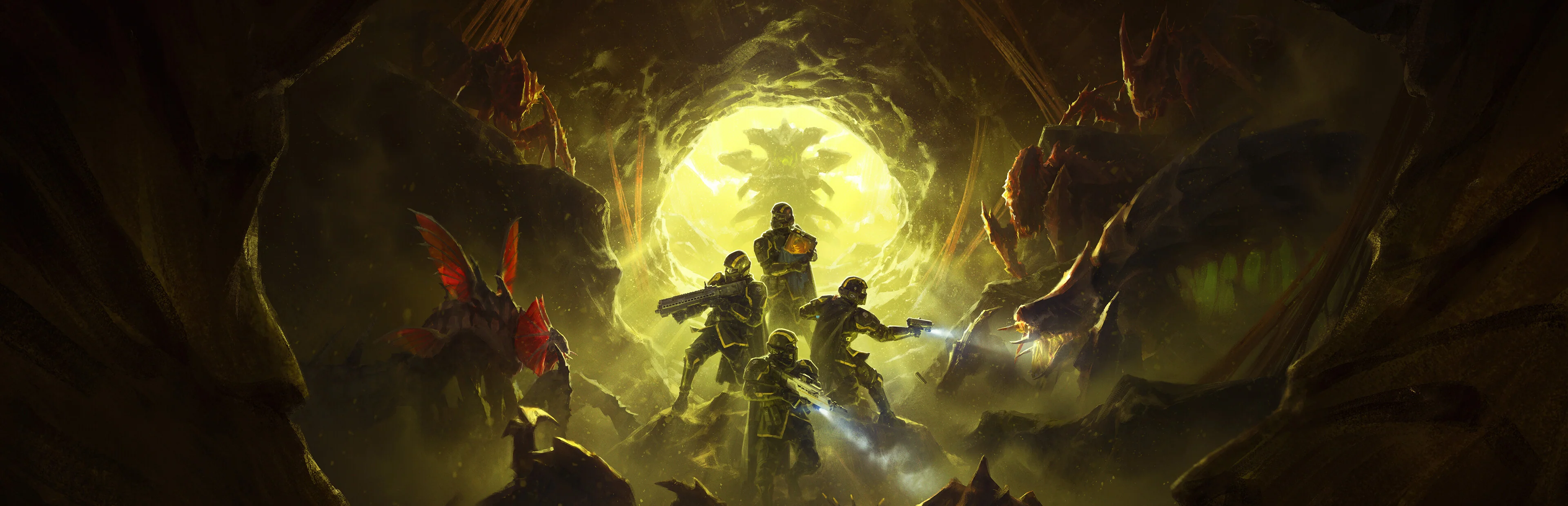
About HELLDIVERS 2
It is a co-op game where the squad shares one reinforcement budget and four stratagem slots each, and where the shooting is only half of what the team is agreeing on.
You can drop alone, and the game will find you a squad
HELLDIVERS 2 is an online game with no offline mode, and that has been read by some as a game you cannot play by yourself. It is not. The squad's shared reinforcement budget is set per diver, so a solo drop starts with five respawns and a full four-diver squad starts with twenty. Playing alone is a supported way to play, just a harder one.
The game also has an explicit answer to the empty-lobby problem. A mission stratagem called the SOS Beacon raises your mission's priority on the galactic map so other players are more likely to join, and it broadcasts until all four squad slots are filled. If you would rather not wait, ordinary matchmaking fills squads without it; the beacon is the deliberate version of the same idea.
What a drop actually asks for
The shape of a mission is set before you land. You bring a primary weapon and pick four stratagems from your ship's armoury, on top of any mission-specific ones the game hands the team, and everyone has to cover a different gap rather than bring four copies of the same answer. The PlayStation listing is unusually direct about the cost of that agreement: friendly fire is always on, and it recommends you talk to your squad about it. Keeping your fire lanes clean is not a HELLDIVERS invention, but the game does put it in the middle of the loadout conversation rather than in a menu somewhere.
It also helps to know what a stratagem actually is, because they are not one kind of thing. The armoury splits into offensive ordnance like orbital and Eagle strikes, supply drops including support weapons and backpacks, defensive sentries and mines, and mission tools such as the resupply and reinforcement calls. An Eagle airstrike is area denial that will absolutely catch a teammate standing in the wrong place; a supply pack, a railgun or a guard dog drone is not, and those are frequently the picks that save a run. The resupply call has a squad-wide cooldown, which is why one player spamming the resupply call can leave the team short.
Three enemies, three conversations
The store listing frames the threats the way the game does: Terminids, the Automaton Collective and the Illuminate, each with distinct characteristics, tactics and behaviour, and all of them fighting without fear or morality. The official breakdown of the Illuminate is a good example of how differently a plan has to be built: floating Watchers that scan for free-thinking lifeforms, Voteless used as expendable shields, and Harvesters with a single-eye beam that punishes anyone standing in the open.
Our read is that this is the part of the game that keeps the loadout question alive. A build that shreds one faction's heavy units can be the wrong answer against another, and because the war moves you between fronts, the squad's composition is a rotating problem rather than a solved one. When the developers describe new enemies arriving as part of the story of a campaign, that is what they mean in practice: the map changes what is worth bringing.
What a Warbond is, and what it is not
Warbonds are the part of the economy a new player needs to understand correctly, and the mistake is assuming one currency is doing all the work. Premium Warbonds are unlocked with Super Credits, which you find at points of interest during missions or buy in the in-game store. Once you own it, the items inside are paid for with Medals, which you earn by playing missions and by completing the community and personal orders. Two currencies, two jobs: Super Credits open the door, Medals walk you through it.
The studio's own Warbond notes are also clear that these are evergreen rather than seasonal. Warbonds do not expire and do not disappear, so you can buy one whenever you like and progress it on your own schedule, and you can put Medals into two different Warbonds at once if you want to. The contents are themed sets of weapons, armour with passive perks, stratagems, vehicle skins, capes, emotes and player titles. So a Warbond is not a story expansion or a season pass with a deadline; it is a page of unlocks you can pick up years from now, and the honest picture is that buying one gives you access to gear you still have to earn your way through.
The war is the campaign
What holds the missions together is the Galactic War, which the store describes as a shared effort where capturing enemy planets, defending against invasions and completing missions all contribute to one result. Community progression and personal progression are tracked separately, so your own goals and the community's push are not the same ladder. The studio has since moved the community layer from the older Major Order format to Galactic War Campaigns, which run for a span of weeks with a stated stake, a visible outcome and at least one reward attached when the conditions are met.
That structure is the reason a session can feel like it matters beyond the squad. Dropping into a defence on one planet, or pushing a front somewhere else, contributes to a number everyone can see, and the studio has been candid that players previously struggled to tell whether their actions were actually changing anything. The most recent release chapter added new objective types such as destroying structures and infiltrating enemy installations, plus SEAF platoons that ride dropships into the fight alongside you. The studio has also described a longer-term plan to overhaul ship progression and add more ships. Those are development intentions rather than shipped systems, and they are the part of this review you should treat as a promise rather than a feature.
What you are buying, and what it costs you
This is a Windows entry on PC and a live game everywhere else: the listing offers multi-player and online co-op only, with no offline mode, though missions can be played solo, and the PlayStation page states plainly that online play is required. It carries an in-app purchase line and a mature rating, so both of those are worth knowing before rather than after. Cross-play exists across the supported platforms, which the studio's own patch notes reference when they describe joining a lobby hosted by another platform.
The practical cost is that this is a game you keep up with rather than finish. The studio is candid about having had a rough stretch on performance and stability and about changing how it patches as a result, and the fix lists across its updates are long. If you want a game that arrives complete and stays still, this is not that game, and it is not pretending to be.
Should you play it
Yes, if you have a regular group and you like the idea of a shooter where the argument about what to bring is as much of the game as the shooting. The friendly fire rule makes every squad a small negotiation, the factions keep the loadout question moving, and the war gives four people a reason to drop into the same map twice.
Skip it if you need an offline game, because it is online-only and there is no campaign mode to retreat into. Skip it if a live balance patch is a dealbreaker, and skip it if you want a shooter where your tools cannot hurt your friends, because in this one they absolutely can. Playing solo is on the table and matchmaking will fill your squad, but a bad drop with strangers is still a bad drop.