
About Dune: Awakening
It has been on PC since 2025, and it arrived on PlayStation 5 and Xbox with the same update that added the solo mode. The desert and the story are the same wherever you play; the survival rules are not, because single-player and self-hosted play let you change them, and who else is standing on the sand is the other thing a mode decides.
Arrakis is the antagonist
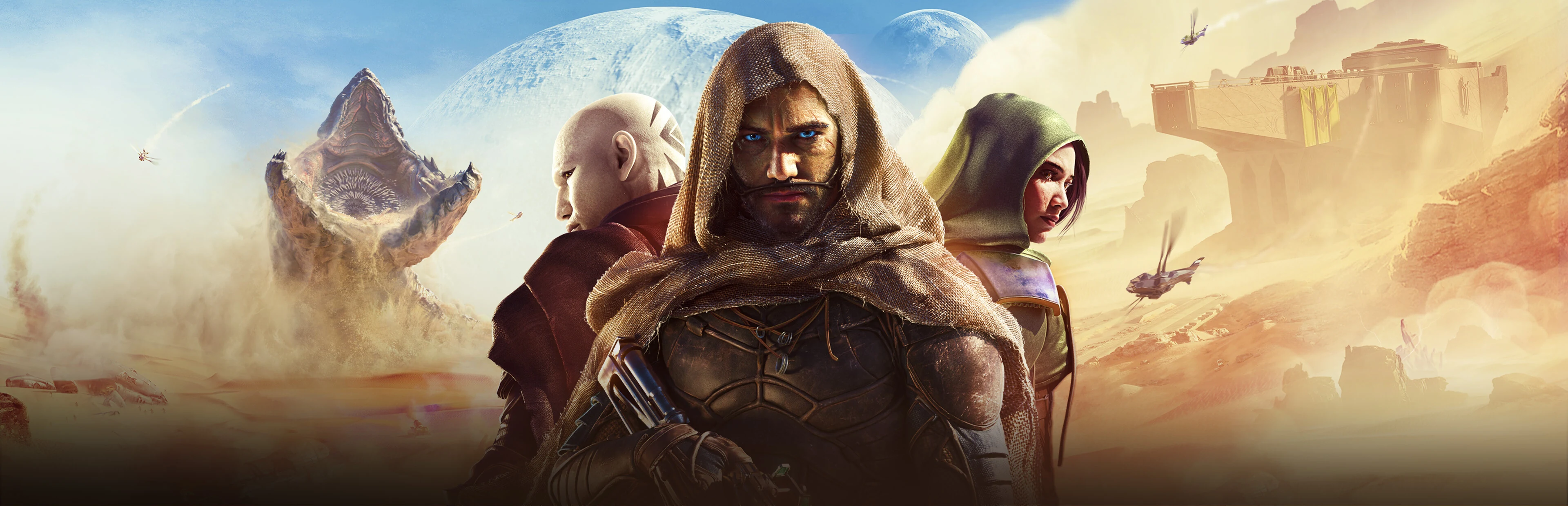
The world does most of the work here. You chase shade to stay out of the sun, and you get water by extracting liquid from the bodies of the things you kill and refining it. Sandstorms sweep the landscape, and the practical answer is to get out of them rather than ride them out. Roaming sandworms make open sand a timed risk rather than neutral ground, and the Deep Desert is the place where that matters most.
The tools you build are what turn that from a nuisance into a route. You can construct ground vehicles and ornithopters, the Shigawire hook gets you up mountains, and flying across sandworm country in something you built yourself is the clearest promise the game makes. Your base is the other half: a place for water, gear and recovery, and where you put it decides how much open sand you have to cross to use it.
The story runs the full length now
You are sent to Arrakis by the Bene Gesserit to find out what happened to the Fremen, and you pick a house to rise through: Atreides or Harkonnen. The famous names are here — Duke Leto, Feyd-Rautha — and the premise the whole thing hangs on is the interesting one. This is a Dune where Paul Atreides was never born.
The reason that matters for buying the game is that the campaign now reaches a conclusion instead of stopping at a content wall. The final Act of Book One arrived with Update 1.5, and the whole of that first book can be played from beginning to end in a single run. It is the end of Book One rather than the end of Dune: Awakening's story for all time, so treat it as a finished arc rather than a finished series. Older story missions were also given rewards retroactively, so a returning character isn't punished for having done them early.
Pick a school and practise it
Progression runs through the Schools of the Imperium, and the game presents them as disciplines to learn rather than buttons to press. The Trooper is firepower. The Bene Gesserit voice controls enemies. The Mentat lays traps. The Swordmaster is a close-quarters fighting style built on the slow blade. Each school also has its own armour set, so the training shows on the character as well as the bar.
The schools are not an exclusive choice, and they solve different problems rather than competing on one ladder. The voice and the traps are the paths that avoid a stand-up fight; the Trooper and the Swordmaster are the ones you take it with. Because every trip onto the sand costs water, time and risk, it is worth deciding which problem you want solved before you leave rather than carrying an answer to a question you are not asking.
Three different games on one planet
Single-player is the new mode and it is not a cut-down version. It is the whole game, on every platform, solo: the same regions, storylines, challenges and rewards. You choose one of three difficulty presets or go through the settings in detail, and a handful of systems were reworked so that a solo player isn't blocked by the multiplayer design. The Exchange becomes a vendor with a large selection you can buy from. The Landsraad simulates rival guilds so the political competition keeps moving without other players. The Coriolis storm stays genuinely dangerous but no longer kills you instantly and wipes your Deep Desert progress. The Cartographer skill extends how far your map reveals.
Self-hosted and private servers are the middle option, and the controls are real: sandstorms, whether the Hagga Basin is fully PvP or fully PvE, harvesting and XP multipliers, building piece limits, item durability, base decay, sandworm and Coriolis auto-spawn, what drops on death, and how many land claims you get. Rented servers vary by provider. Official servers are the shared world, where alliances, rivalries and the politics of Arrakis involve other players.
The character rules are where the three modes meet, and they're worth reading before you commit. Single-player characters stay in single-player. Official-server characters can be played on any official server and can be moved down to a private or self-hosted server, but that trip is one-way. Private and self-hosted characters can move between private and self-hosted servers, and a transfer moves the character rather than copying it. Bases and vehicles come with you only if you back them up first. Cross-play between platforms has been announced for after the console launch, with no date yet, so treat it as coming rather than current.
What the big update actually changed
Update 1.5 is free, and it's the reason to look at the game now rather than at launch. Alongside the solo mode and the story ending, it rebuilt how you hold a roster: characters are the centre of the experience rather than servers, with a character list on the main menu and backed-up bases and vehicles that travel with you. Bosses that used to mean queuing on a busy server, such as the Echoes of the Past, the Glutton, the Paranoid and the Jackal encounters, are now instanced.
Combat got a pass as well, aimed mostly at melee: the parry window was widened and the enemy combo animations were changed. The console build also brought technical work on world streaming, rendering, memory, collision and physics, and that landed on PC at the same time.
What is free and what you pay for
Update 1.5 is included with the base game; its new mode and story content do not require a separate expansion purchase. Free extras around it include a welcome-back package scaled to your research tier for returning players, a decorative reward for playing during the console launch window, and a separate free content pack. Everything you already own in story rewards is granted retroactively.
The paid side is optional, and it is worth reading what each pack actually contains rather than treating the whole group as one thing. Filmic Archive is the one to know about: it brings looks inspired by the recent Dune films — the Aegis of the Unwalked Path, the Caladan Stormcoat, Harkonnen and Atreides armour sets, a stillsuit and three Sardaukar sets — plus Sardaukar weapons, emotes and a 73-piece Sardaukar building set with 17 matching decorations, which changes what you can build as well as how it looks. It is a content pack rather than a story expansion. There is also a Season Pass and further content packs, all of which need the base game.
Should you play it
Yes, if the Arrakis fantasy is the draw — building a base, flying your own ornithopter, running the story — and you would rather other people's guilds didn't decide your day. That is now a supported way to play rather than a compromise, with the whole game available solo and settings that let you turn off the specific systems you dislike.
If the social layer is the draw, pick the mode for it rather than skipping the game: the politics, the rivalries and the crowded desert live on the official servers, and private and self-hosted servers let you bring a smaller group of friends to the same world on your own rules. If you want cross-play today, that's announced rather than available, and the same applies to the Polar Cap, a free survival map that is coming later rather than now.
Go deeper with V4mp
- Developer
- Funcom
- Genre
- Open-world survival
Explore Dune: Awakening further
Explore the wiki for detailed reference pages on the game's world, systems, items and locations.