
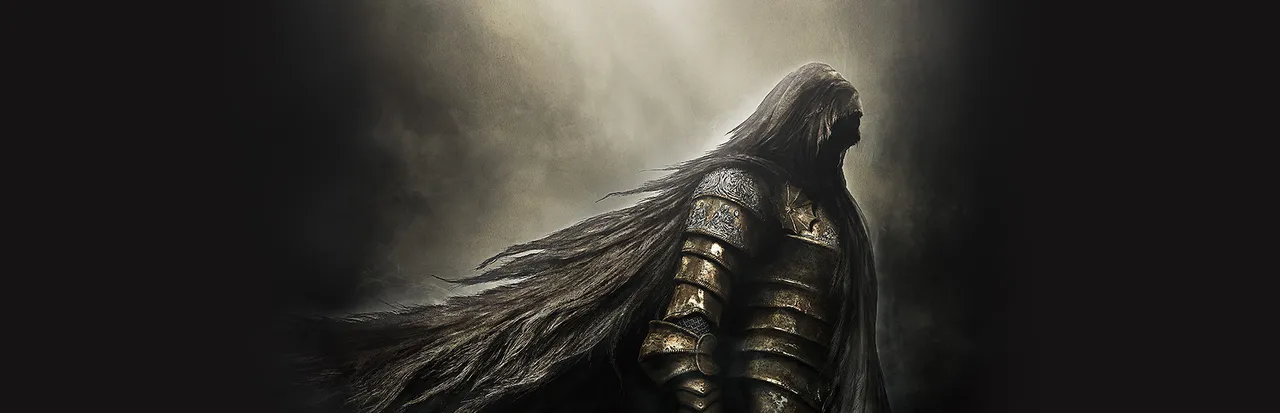
About Dark Souls II
FromSoftware's 2014 sequel was built by new directors with an explicit brief: keep the teeth, lose some of the intimidation. It mostly works, and the place where it doesn't is one mechanic you'll meet in your first hour.
Drangleic is a friendlier kind of horrible
The opening is the clearest break from Dark Souls. Where the first game dropped boulders on your head before you'd found your footing, this one gives you a gentle starting area with threats you can see, then hands you off to the hub town of Majula — a bright, oddly welcoming little place under a sun that never quite sets, where a small band of locals wait to talk to you.
Majula matters because it's the only place you can level up, so you keep coming back. You'll speak to a woman there, she'll tell you to find the king and hunt great souls, and that is essentially the total direction the game gives you. Bonfires are scattered across Drangleic and do what bonfires do — rest, heal, refill your flask — but the level-up ritual being tied to home means the hub never stops being part of the loop. It's a quietly smart bit of design that later entries in the genre borrowed without improving.
More roads than you need
The other thing this game does well is offer escape routes. There is almost always more than one way onward: if a dock full of fire-throwing marauders is beating you, go down the well instead and find a tomb full of talking rats. That's genuine non-linear structure rather than a hub with three spokes, and it means a wall in one direction rarely ends a session. For a game this punishing, being able to leave is what keeps it playable.
The mechanic that goes too far
Death reduces your maximum health until you use a Human Effigy, and those are scarce through the first half of the campaign. It's the one place the design fights itself. Punishing you for dying is fair game; making you reluctant to explore because a bad run permanently shrinks the bar you need for the next one is a tax on exactly the behaviour the rest of the world is built to reward. It has precedent in Demon's Souls, and it's still the least popular thing the series has done.
The pulse
Dark Souls II has settled into being the series' awkward middle child, and the reasons are more about circumstance than quality. It was made by different directors without the original's lead at the helm, and it followed a game that had already become a landmark, so every deviation reads as a step away from something people had decided mattered. The recent reappraisal has been kinder: the route variety and Majula hold up better than their reputation, while the hollowing penalty and the looser-feeling world construction remain the standard complaints. It's the one entry where the argument is still genuinely live rather than settled.
Should you play it
Yes, and especially if the first game's opening put you off. This is the most forgiving entry point in the trilogy, not because it's easier in the fights but because it lets you breathe at the start and gives you somewhere else to go when you're stuck.
Play it after Dark Souls and III if you're working through them in order, not instead of either. And go in expecting the health penalty, because it will shape how boldly you explore and there's no way around it until the Effigies start appearing.
Go deeper with V4mp
- Developer
- FromSoftware
- Genre
- Dark fantasy action RPG
Explore Dark Souls II further
Explore the wiki for detailed reference pages on the game's world, systems, items and locations.