
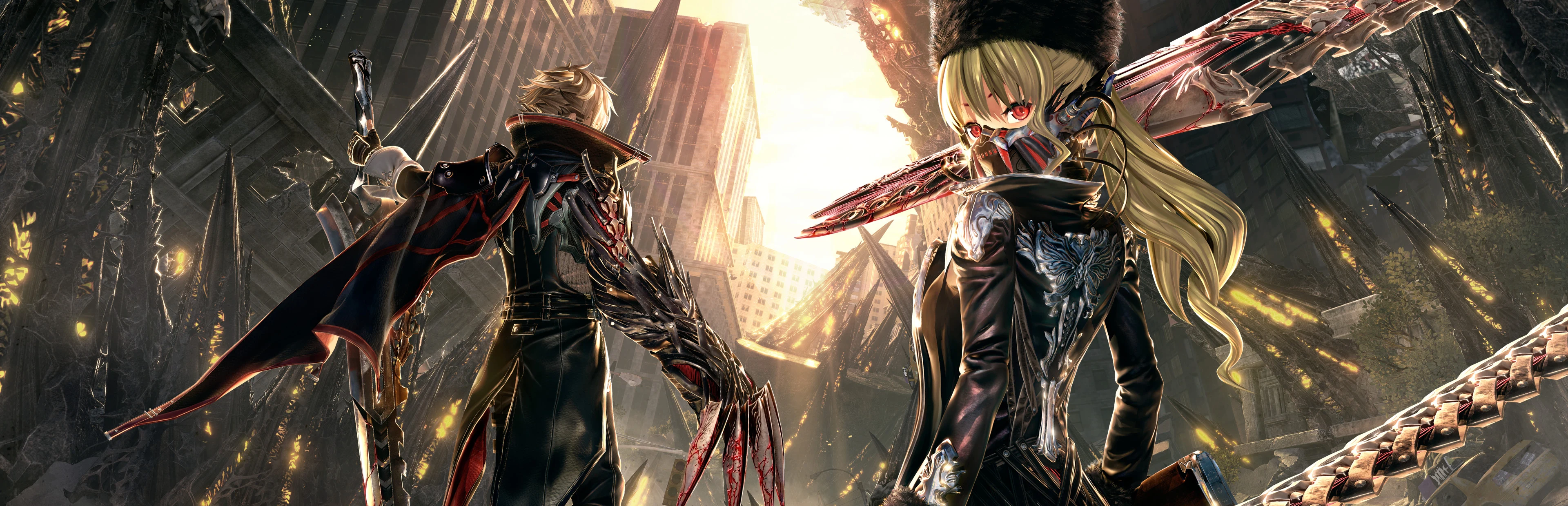
About CODE VEIN
Bandai Namco Studios built it and Bandai Namco Entertainment published it, and it launched on PlayStation 4, Xbox One and PC in late September 2019. This review covers the base game, the Season Pass add-ons Hellfire Knight, Frozen Empress and Lord of Thunder, and the Deluxe Edition versions of all of it. It is the original Code Vein, the one from 2019, not Code Vein II.
Your class is a Blood Code you can swap
Blood Codes are how Code Vein does classes. You start with three, Fighter, Ranger and Caster, and you collect more as you go by meeting people and by restoring the memories locked in the Vestiges you find. The important part is that nothing about them is permanent. You can change the code you have equipped at any time, and since your stats come from the code rather than from points you spend, switching one out rewrites what your character is actually good at.
The catch is that a code brings its own Gifts, its own stat spread and its own weight allowance, and it also decides whether the weapon in your hands behaves the way you want. Gifts live inside a code, and the better ones have stat requirements, so the same pistol-axe build can feel completely different depending on the code underneath it. Most Gifts can be mastered and then used by other codes, which is the real progression here: you are not levelling a class, you are collecting the pieces that let you stop needing it. Exclusive Gifts are the exception and stay where they are.
Ichor, Focus and the heal in your pocket
Active Gifts run on Ichor, which doubles as the ammunition for bayonet rifles, so your spells and your gun share one bar. You refill it by hitting things: melee swings, a good parry, a backstab, a Blood Veil drain or a boss kill all give something back, and a drain attack raises the amount you can hold on top of that. That temporary ceiling disappears the moment you rest at a Mistle or die, which is the game's way of saying the buffer is for the fight in front of you.
Regeneration is your main healing item. It restocks at a Mistle and on death, and you upgrade it with items rather than with a stat: the Regen Extension Factor permanently raises how many uses you carry, up to ten, or twelve with the Augmented Regeneration passive, the Regen Activation Factor raises how much each use restores, and the healing itself is a flat amount rather than a percentage of your health. Focus is the other meter worth watching. It fills when you take a hit or dodge one cleanly, and a full gauge returns your stamina, makes you harder to stagger, and unlocks a launch attack that combos straight into a drain. Enemies run the same gauge, and a full one means they are about to get the same advantages, so the blue glow is a warning rather than a gift. Bosses skip the gauge entirely.
The Blood Veil does three jobs at once
A Blood Veil is armour, but it is also your parry and your drain tool, and it is the piece of gear that decides how a fight is paced. There are four types, Ogre, Hound, Stinger and Ivy, and each one changes the shape of your charged drain attack along with the animation and startup of your parry, which means the same input has a different window depending on what you are wearing. The stats on a Veil scale drain damage and the damage of light and dark Gifts rather than your weapon damage, and the type itself raises the potency of the Gifts you favour.
Weapons run in five families: one-handed swords, two-handed swords, polearms, hammers and bayonet rifles. You carry a main and a sub weapon and swap between them without opening a menu, and the choice is not free, because weight drives your mobility and unmet stat requirements cut your attack power badly. Upgrading happens at Rin Murasame in the Home Base, running from +1 to +10 along a material ladder of Queen Iron, Queen Steel, Queen Titanium and finally Queen Tungsten. Besides levelling a weapon up, you can transform it: transformations cost 10,000 Haze each and trade some of your scaling for elemental damage, a status effect or a shift in how the weapon behaves.
Mistle is a checkpoint, a shop and a trap
Mistles are the bonfires. Resting restores your HP, your Regeneration uses and your Ichor, saves the game, maps the area around you, and brings every ordinary enemy you have already killed back to life. The same menu is where you level up, teleport between purified Mistles, change who is fighting beside you, and spend Haze to inherit Gifts from the codes you have collected.
Haze is experience and currency at once, and it is unforgiving about it. Die in a dungeon and everything you were carrying drops at the spot where you fell, and you get one trip to go and pick it up. Die again on the way and it is gone, along with the upgrade or the Gift it was going to pay for. There is a subtler cost than that, though. Levelling caps out at 300, and every area has its own ceiling on the Gift experience you can earn there, so a player who over-levels early stops making progress on mastering Gifts in the areas they are still exploring. Going up a New Game Plus cycle raises that ceiling again, which is the real argument for finishing a region before you grind it out.
Depths are where the endgame lives
The Depths are the endgame. They are separate dungeons you unlock with maps, hand-built rather than generated, and they are full of keys, chests and bosses, with a reward table that climbs as the maps get nastier and runs from Queen Iron up to Queen Titanium. The Tower of Trials sits at the top of that ladder: three towers numbered I to III, each one a run of six floors of fights in a row, paying out consumables like Regen Inducers, Pure Blood and Marks of Honor. You can take a partner or a co-op guest into the Depths, which makes them the most practical place to farm with someone else.
Your partner is a build choice
You take one companion into the field and it is not a cosmetic decision. Each of them arrives with a fixed weapon, a fixed Blood Veil and a defined job, from Io's support casting to Yakumo's heavier melee, and you cannot change what they are carrying. They fight their own way, so you steer them by picking who comes along rather than by issuing orders: they flank, they buff, they heal you, and some of the Gifts you can equip are Communal ones keyed to a named partner. When yours goes down you can bring them back with Restorative Offering inside a short window, paying a chunk of your own health rather than hiking back to a checkpoint. They return the favour too: a partner can pull you back up when your health hits zero, and the notes on Io's revive are mostly about how much of her own health that costs her.
Not all of them are just handed over. Eva Roux is the clearest case, and the work happens before and during the Successor of the Throat rather than after it: collect every Harmonia fragment, rebuild the Harmonia Vestiges, and once that boss is down follow the memory through and restore hers before you walk out. Miss any of that and she is off the table until a New Game Plus run or a fresh save.
Co-op is three characters and one save file
Online play runs on distress signals from the multiplayer menu. A host sends one out and a guest answers, and with the host's companion still in the party that field can hold three characters at once. The guest is levelled to match the host and has a smaller pool of Regeneration, cannot pick up items that were placed in the host's world, and cannot start a boss fight on their own, though they can join one the host has already begun. Progress is saved only on the host's world, so the guest is there to help and to take enemy drops rather than to advance their own story.
Three endings and a reason to save everyone
The story pushes you through the Successors, and the game quietly grades you on how many of them you leave behind. Each Successor has Vestiges tied to them, and if you collect and restore those before the fight and then restore their memory afterwards, you save them. Save none and you get Heirs, the ending where your character loses the argument with the Relics inside them. Save some and you get To Eternity. Save all four and you reach Dweller in the Dark, with one extra scene if you also repaired every Eos Vestige before the final fight. That is three endings plus a fourth reward for the lot, and the collectible work is spread across playthroughs, so a single run does not show you everything the game has.
What the three DLC packs add
The Season Pass covers three packs, sold separately as well as bundled. Hellfire Knight arrived first in January 2020 with a new boss and the Fiery Oblivion depths. Frozen Empress followed in February with the Celestial Ice Prison. Lord of Thunder closed it out in March with the Eternal Abyss. Each one adds a boss, weapons, Blood Veils, at least one new Blood Code and alternate outfits for your partners, so the packs are aimed at players who have already finished the story and want new fights with new tools rather than a second campaign.
Each of those depths also carries its own Horror Hunting Trials, and they are the closest Code Vein gets to a difficulty toggle. You pick them up at the mistle for that depth, and they run on two separate dials: a difficulty setting that raises the strength of the enemies down there, and a list of bonus objectives to clear along the way, such as landing the first hit, surviving a set number of seconds, or chaining attacks and evades without taking damage. Each objective pays out once, and the rewards run from cosmetics and consumables to weapons and Blood Veils, with the hardest variants sitting behind the higher difficulty settings.
Should you play it
Yes, if the idea of a soulslike that lets you rebuild your entire character between attempts appeals to you. The freedom is real, and it is the reason Code Vein has stayed in the conversation: the same save file can be a support caster for one fight and a greatsword bruiser for the next, and the only thing you lose is the time you spent learning the fight. The character creator deserves the reputation it has, with 32 presets and enough sliders to make almost anyone, though gender, physique, face and voice lock in once you start and cannot be changed later.
Skip it if you want the sequel's system. Code Vein II has moved on from what is here, and coming back to this one expecting that toolkit is going to feel like a step backwards rather than a prequel. Skip it as well if you want hand-authored level design above all else: the areas are long and looping here, and the Depths are good in part because they are tighter than the story regions around them.
On Steam the storefront summary reads Very Positive across roughly 62,000 reviews, and the game's post-launch support ran through the three packs above across 2020.
Three things before you buy
Check the edition against the DLC. The Standard Edition is the base game. The Deluxe Edition pairs the game with the Season Pass and adds the Mia bonus content and the Insatiable Bloodthirst accessory pack. There was also a physical Collector's Edition, and it was console only: a 17cm Mia Karnstein figurine, a collector box, a soundtrack of over twenty tracks, an artbook and the same Insatiable Bloodthirst set. If you are hunting one down now, check what the listing actually includes.
Decide on the weapon before you spend Haze. Upgrades run to +10 through four tiers of Queen material, and every transformation costs 10,000 Haze on top of the chrome it uses, so a weapon you upgrade on a whim is a weapon you get to pay for twice. The same is true of Gifts: mastering them costs Haze, and the areas you have already out-levelled will stop paying out the Gift experience you need.
Set expectations on the co-op. You get one guest, not a full party of friends, and the guest's progress does not carry home. If your plan is to play the whole game with someone else, be ready to run every area twice, once for each of your saves.
Go deeper with V4mp
- Developer
- Bandai Namco Studios
- Genre
- Action RPG
Explore CODE VEIN further
Explore the wiki for detailed reference pages on the game's world, systems, items and locations.