
Start CS2 With a Clear Practice Plan
On this page
Give your first CS2 session three achievable targets: learn a route, practise one weapon and help a teammate finish a round. Keeping those targets small makes it easier to identify what went wrong and choose something useful to practise next.
Learn one map before collecting line-ups
Open Play > Practice, choose a map and enable Load Map Guides. Valve introduced this option to let players practise with grenade guidance. Treat the guide as a learning aid while you explore the actual level. Valve’s map-guide update.
Walk a route toward each bombsite, then find a route between the sites. Repeat the journey in reverse. Notice where the route branches, where you could stop behind cover and which entrances you would need to watch. Learn the location names shown in the game so your calls match your teammates’ language.
In bomb-defusal play, keep the objective in view: the T side works toward planting and defending the bomb; CTs work toward preventing the plant or defusing it. When you feel lost, choose one useful job: follow a teammate, watch an entrance or cover the player dealing with the bomb. You do not need to lead the whole team to contribute.
Try a three-part first session
Try ten minutes exploring, ten minutes practising a rifle and ten minutes playing Retakes. Adjust those blocks to suit your attention and experience.
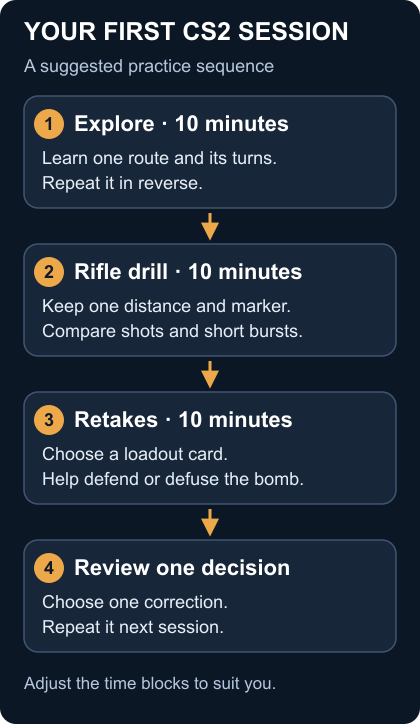
For the rifle drill, stand in a quiet practice area and choose a small wall detail as your aiming marker. Compare isolated shots with short bursts. Keep your starting position and distance consistent, then look at the fresh impacts after each attempt. Concentrate on a repeatable action before adding speed.
Retakes gives you a focused way to practise the objective. Valve describes it as a 4v3 after-plant scenario: choose a loadout card and work with teammates to defend or defuse the planted bomb. Start by watching how your position affects the person moving toward the objective. Valve’s Retakes introduction.
Retakes uses its own loadout selection. Practise ordinary round purchases separately before expecting those choices to feel familiar in Competitive.
Prepare a loadout and a short call
Choose weapons for both T and CT loadouts. For learning, start with one main rifle and an affordable alternative you intend to practise. The buy menu shows teammate equipment, and unused purchases made in the same round can be refunded. Check those indicators before committing to your own purchase. Valve’s loadout and buy-menu explanation.
Ask whether the team is buying or saving. Then make a purchase you can explain: which job will this weapon help you do, and what else does the round require? Follow the economy and buy-round guide when those decisions start to feel rushed.
Keep information calls short: where you saw an opponent, how many you actually saw and where they were heading. Say when information is uncertain. After giving the useful detail, leave room for other players to speak and listen.
Understand the account requirements
Free CS2 provides access to game modes and matchmaking except Premier. Premier requires Prime Status and Profile Level 10. Prime is also required to earn XP, Competitive Skill Groups and CS Rating. A pre-made lobby containing Prime and non-Prime friends enters non-Prime matchmaking. Steam Support’s Prime FAQ.
Competitive Skill Groups belong to individual maps; the client shows the wins needed to earn one. CS Rating belongs to Premier, while profile rank grows through match XP. Those are separate forms of progress. Steam Support’s rank explanation.
Finish by choosing one correction for your next session. Repeat a confusing route, rehearse a clearer call or work through the aiming, movement and utility drills. Give that correction a few deliberate attempts before changing the rest of your routine.