
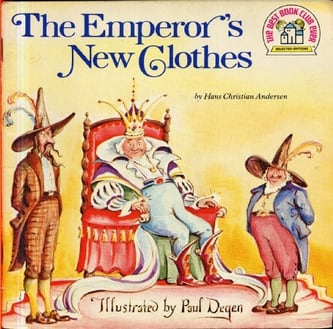
The emperor's new clothes
The Emperor's New Clothes is a literary fairy tale by the Danish writer Hans Christian Andersen.
About
The Emperor's New Clothes belongs with The Little Mermaid in the third and final instalment of Andersen's Fairy Tales Told for Children, which came out in Copenhagen on 7 April 1837 from the house of C. A. Reitzel. In the century and a half since, the tale has been translated into more than a hundred languages.
Its emperor cares about fine clothes above everything else and spends money on them that ought to be going to the business of the state. Two strangers arrive in his capital and, passing themselves off as weavers, offer him a suit of clothes with a remarkable property: it cannot be seen by anyone who is incompetent or stupid.
The emperor takes them up on it, and the weavers set up their looms and pretend to work. Officials come to inspect the cloth, beginning with a minister who is supposed to be wise and competent, and each of them sees empty looms and says nothing, unwilling to be thought a fool. The emperor himself does the same, and when the weavers announce that the clothes are ready he is dressed in nothing and goes out in procession through the city. The crowd keeps up the pretence until a child says plainly what everybody can see.
The tale is adapted constantly for stage and screen, and its title, together with the observation that the emperor has no clothes, has passed into the language as a way of describing a collective refusal to admit the obvious.
Book details
- Author
- Hans Christian Andersen
- First published
- 1837
- Series
- No series listed
- Subgenre
- Fairytale retelling, Classic fantasy
- Primary genre
- Fantasy
- Tags
- No tags for this book.
Rating
Review
Editor profile
Baby Bat
Goodreads and social links will be added soon.
- Goodreads — link coming soon
- Social media — link coming soon