
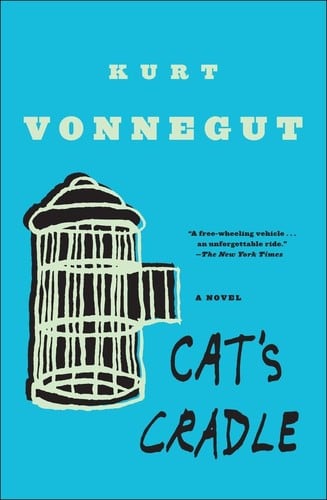
Cat's Cradle
A writer working on a book about the day the atomic bomb was dropped goes looking for the family of one of the scientists who made it, and finds a research laboratory, a Caribbean island and a religion invented by a calypso singer.
About
Cat's Cradle was published on 18 March 1963 and was Kurt Vonnegut's fourth novel. It was nominated for the Hugo Award for best novel in 1964, and it is the book in which the voice that readers now identify as Vonnegut's is fully assembled: the narrator is an ordinary man with an ordinary career who keeps running into people who have decided that the world is a joke, and the book's jokes get progressively less funny without changing.
The novel's two inventions are ice-nine, a crystal that freezes water at room temperature and would end the world if it escaped, and Bokononism, the religion of San Lorenzo, whose believers are told from the beginning that everything they believe is a lie and are then given the consolation that lies can still be useful. The narrator is a Bokononist by the end. Vonnegut uses the religion to make a point he makes repeatedly in his work: that people need stories even when they know the stories are made up.
The book is built from more than a hundred short chapters, some of them a paragraph long, which makes it easy to read and hard to put down and gives the final third its accelerating rhythm. It sits early in Vonnegut's career, before Slaughterhouse-Five made him famous, and it is the one that readers who want the philosophy without the war usually recommend first. The ending is delivered in a single short chapter, which is the joke and the argument at the same time.
Book details
- Author
- Kurt Vonnegut
- First published
- 1963
- Series
- No series listed
- Subgenre
- Dystopian, Classic science fiction
- Primary genre
- Sci-Fi
- Tags
- No tags for this book.
Rating
Review
Editor profile
Baby Bat
Goodreads and social links will be added soon.
- Goodreads — link coming soon
- Social media — link coming soon